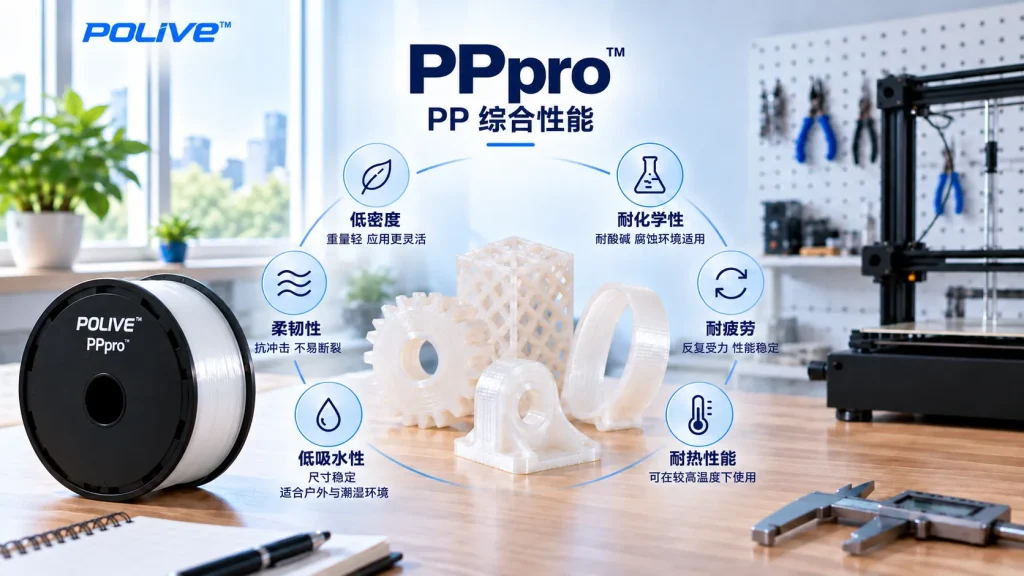
How to Choose 3D Printing Materials? What Is PP’s Overall Performance Like?
When it comes to FDM 3D printing materials, many people first think of PLA, ABS, PETG, and PC.
Each of these materials has its own characteristics, and PP (polypropylene) is also a very noteworthy engineering plastic.
What makes PP special is not that it ranks first in every single property, but that it can simultaneously offer a variety of practical material characteristics:
- low density
- Good chemical resistance
- Low water absorption
- Good flexibility
- Good fatigue resistance
- Good heat resistance
- Recyclability
Therefore, from the comprehensive requirements of functional parts, PP is a material with unique advantages.
Why Is PP Worth Attention?
If you compare several common performance dimensions of 3D printing materials, you’ll find PP’s characteristics are very distinct.
1. Low density
The typical density of PP is about 0.90 g/cm³, which is lower than the density of water.
This means that, at the same volume, PP parts are usually lighter than many common plastics.
This is an important advantage for:
- Lightweight structural parts
- Drone and model components
- Buoyancy-related parts
- Wearable products
- Sports equipment accessories
low density is an important advantage.
2. Good chemical resistance
PP has good resistance to many common acids, alkalis, and chemical media.
This makes PP valuable for functional parts that need to contact:
- cleaning agents
- aqueous solutions
- acid/alkali media
- certain chemicals
.
However,“Chemically resistant” does not mean “resistant to all chemicals.”
Actual performance is also affected by factors such as the type of chemical, concentration, temperature, contact time, material formulation, and internal stress of the part.
3. Good fatigue resistance
A highly representative characteristic of PP is its goodrepeated bending and fatigue resistance.
This is also why PP has long been widely used in industrial products forliving hinges (Living Hinge).
For 3D printing, this means PP is suitable not only for static parts but also for designs that require:
- Repeated bending
- Snaps
- flexible connections
- integrated open/close structures
.
Of course, the fatigue resistance of FDM parts is also closely related to print orientation, interlayer bonding, wall thickness, hinge structure, and printing parameters.
4. PP’s heat resistance
PP generally has higher heat-resistance potential than PLA.
However, when discussing “heat resistance,” you cannot simply use one temperature to judge whether all PP parts can be used long-term.
A material’s:
- glass transition temperature (Tg)
- Heat distortion temperature (HDT)
- melting temperature
- long-term service temperature
represent different concepts.
For actual 3D printed parts, you also need to consider:
material formulation + printing parameters + part structure + load conditions + service time + ambient temperature
Rather than simply saying “PP can withstand over 100°C,” a more accurate approach is to evaluate it based on the specific material and actual test conditions.
POLIVE PPpro™ has also conducted real high-temperature application tests, such as 100°C boiling water test, to observe the stability of printed parts in high-temperature water environments.
5. PP has low water absorption
Compared with materials with noticeable moisture absorption such as PA (nylon), PP has lower water absorption.
This is a practical advantage for parts used in:
- humid environments
- aquatic environments
- outdoor environments
- functional applications requiring low moisture-absorption impact
.
The effect of material moisture absorption on dimensional and mechanical properties is also a factor worth considering when choosing 3D printing materials.
How Does PP Differ from Common 3D Printing Materials?
Different materials excel in different areas.
| Performance Dimension | PP | PLA | ABS | PETG | PC |
| low density | ★★★★★ | ★★★ | ★★★ | ★★ | ★ |
| Chemical resistance | ★★★★★ | ★★ | ★★★ | ★★★★ | ★★★ |
| flexibility | ★★★★★ | ★★ | ★★★★ | ★★★ | ★★★ |
| fatigue resistance | ★★★★★ | ★★ | ★★★ | ★★★ | ★★★ |
| Ease of printing | ★★ | ★★★★★ | ★★★ | ★★★★ | ★★ |
| High-temperature application potential | ★★★★ | ★ | ★★★ | ★★★ | ★★★★★ |
**Note:** The above is a general comparison of material characteristics, not a quantitative ranking under unified experimental conditions. Different brands, formulations, printing parameters, and part structures all affect actual performance.
PP is not the best in every single property
This is the key to understanding PP.
If you compare only a single metric:
- PC has advantages in high temperature and rigidity;
- PLA is generally easier to print;
- PETG has its own advantages in ease of printing and toughness;
- ABS also has mature applications in heat resistance, toughness, and industrial use;
- whereas PP stands out in low density, chemical resistance, flexibility, and fatigue resistance.
So, rather than discussing “which material ranks first,” it is better to ask:
What properties does this part actually need?
If a part is mainly for display, PLA may already be sufficient.
If you need lightweighting, flexibility, chemical resistance, low water absorption, or repeated bending, then PP’s advantages become more pronounced.
PP’s biggest problem used to be not its material performance, but printing
PP’s material properties are actually not new.
What truly limits the adoption of PP in desktop FDM 3D printing is itsPrinting Difficulty.
Traditional PP easily encounters the following during FDM printing:
- shrinkage
- Warping
- difficulty with first-layer adhesion
- interlayer bonding issues
- high requirements for print stability
This is also why POLIVE developed PPpro™ .
PPpro™ is a modified PP filament developed for FDM 3D printing, aiming to improve the print performance of traditional PP through material design, making it easier for users to apply PP’s material characteristics to real 3D printed parts.
PPpro™: Making PP Easier to Use in FDM 3D Printing
PPpro™ cares about more than just “whether it can be printed.”
More importantly:
whether the printed part can truly leverage PP’s material advantages.
From low density to chemical resistance, flexibility, fatigue resistance, and low water absorption, PP offers a material choice for functional 3D printing that differs from PLA, ABS, and PETG.
This is also why POLIVE started with PP:
to make a material that was previously difficult to print but has many practical characteristics easier for FDM users to work with.
Conclusion
PP is not the “number one” in every performance metric.
But its value lies inthe combination of multiple properties:
low density + low water absorption + chemical resistance + flexibility + fatigue resistance + good heat-resistance potential + recyclability
For functional 3D printing, this combination is very attractive.
One of the main issues that limited PP’s application in the past is the high difficulty of FDM printing.
POLIVE PPpro™’s goal is to make PP easier to print and easier to apply.
Ultimately, the choice of which 3D printing material to use should still be determined by the part’s specific service environment, mechanical requirements, temperature, chemical media, and printing difficulty.
选 3D 打印材料时该先看什么?
先看零件工况:温度、是否接触化学介质、会不会反复弯折或跌落、要不要轻量化。而不是先看参数表上哪个强度数字最高。
PP 的综合优势在哪?
密度低、耐化学、抗疲劳、吸水率低、耐热表现好,而且韧性好不易脆断。它不是单项冠军,但功能件常用的几项都不拖后腿。
PP 过去最大的短板是什么?现在怎么解决?
短板不在材料性能,在打印:半结晶收缩翘边、首层粘不住、层间结合弱。现在靠改性线材加开放式打印解决——不加热床、不封箱,首层用裙边加 PPLOCK26811,零件端做圆角、老鼠耳朵和均匀壁厚,在 Bambu A1 这类机器上就能稳定打。
Related Reading
·Can PP Replace PLA? Not a Replacement, but an Additional Option
·Can PP Make Living Hinges? Printing One-Piece Living Hinges with POLIVE PPpro™
·How Chemical-Resistant Is PP? Understanding the Chemical Resistance of PP 3D Printed Parts