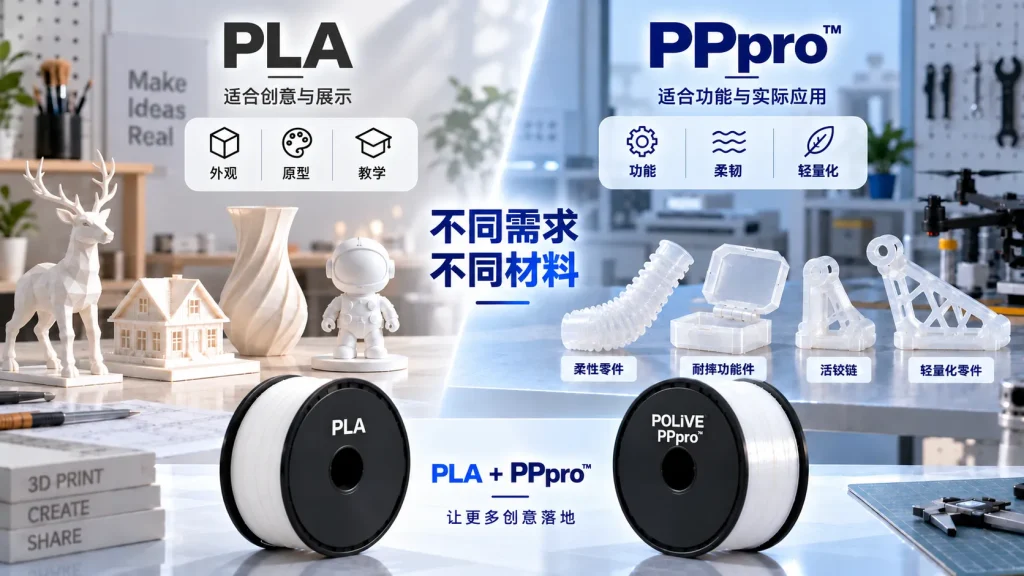
Can PP replace PLA?
If you have to answer this question:
Not necessarily.
PLA and PP are two 3D printing materials with completely different properties.
PLA is relatively inexpensive, easy to print and available in many colors, making it well suited for:
- Decorative items
- Models
- Teaching aids
- Proof-of-concept
- General prototypes
PP, on the other hand, is better suited to functional parts that demand more from the material.
So, rather than saying PP is a replacement for PLA, it is more accurate to say:
PP offers another material option for the applications PLA cannot cover.
What are PLA’s strengths?
There are good reasons why PLA has become one of the most common FDM 3D printing materials.
It typically offers:
- Good ease of printing
- Good dimensional stability
- A wide range of colors
- Good surface finish
- Relatively low material cost
For many models and prototypes, PLA is perfectly adequate.
If your goal is simply to:
quickly print a model, validate a design or make a decorative item, PLA is often a very convenient choice.
Where does PLA fall short?
Problems appear once a part starts taking on more real-world functions.
For example, when a printed part has to face:
Higher temperatures
PLA has limited heat resistance.
If a part is exposed to elevated temperatures for long periods, its dimensions and mechanical properties may change.
Chemical media
PLA’s resistance to different chemicals differs from that of PP.
If a part will be in long-term contact with certain chemical media, the material must be chosen based on the specific chemical and the service conditions.
Repeated bending
PLA is generally quite rigid, but flexibility and fatigue resistance are not its strong points.
If a part needs repeated bending or cyclic motion, PP may be worth considering.
Drops and impacts
For parts likely to be knocked or dropped, toughness and impact resistance also matter a great deal.
This does not mean PLA will necessarily fracture under every impact condition; rather, it shows that PLA and PP differ markedly in how they deform and fail.
Is PPpro™ an “upgrade” over PLA?
If by “upgrade” you mean better performance than PLA in every respect, then the answer is no.
PPpro™ is not a material that replaces PLA across the board.
What it offers is a different combination of properties.
PP itself offers:
- low density
- Low water absorption
- good chemical resistance
- flexibility
- good fatigue resistance
- Good heat resistance
These characteristics make PP better suited to certain functional applications.
So the more accurate way to put it is:
PPpro™ is not an all-round upgrade to PLA, but another material option for applications beyond PLA’s typical range.
Can PLA and PPpro™ be used together?
Yes.
A project is not limited to a single material.
In fact, for some product development projects, different materials can be chosen for different parts based on their function.
For example:
Appearance parts → PLA
If a part is mainly responsible for:
- Appearance
- Color
- Model display
- Surface finish
PLA can be a convenient choice.
Functional parts → PPpro™
If another part needs:
- Lower weight
- flexibility
- Chemical resistance
- Repeated bending
- Good fatigue resistance
Then PPpro™ can be another option.
In other words:
Not PLA vs PP, but PLA + PP.
Let different materials each take on the work they are better suited to.
A Simple Way to Think About Material Selection
The choice can be understood simply as:
If you care more about:
Easy printing + appearance + color + model display
→ consider PLA
If you care more about:
Low density + flexibility + chemical resistance + fatigue resistance
→ consider PP
If both needs exist at the same time:
→ use them separately for different parts: PLA and PPpro™
This is why an experienced 3D printing user usually does not keep just one material on hand.
Why did POLIVE start with PP?
POLIVE does not want users to stop using PLA.
PLA already covers the basic needs of many 3D printing users.
What POLIVE cares about more is a different question:
When users need PP’s material properties, why can’t PP enter FDM printing as easily as PLA?
Conventional PP tends to run into the following in FDM printing:
- shrinkage
- Warping
- difficulty with first-layer adhesion
- interlayer bonding issues
These problems have limited the use of PP in desktop 3D printing.
POLIVE therefore developed PPpro™, which improves PP’s printing performance through material modification, making it easier for users to apply PP in FDM 3D printing.
What does PPpro™ add to your material library?
For 3D printing users, more materials does not necessarily mean better.
What really matters is:
whether you have a suitable material to choose when a project presents a new requirement.
PLA handles many model and prototype tasks very well.
PPpro™, however, can be used where
lightweight + flexibility + chemical resistance + fatigue resistance
are required, offering another option.
The point of PPpro™ is not to “eliminate PLA”, but to:
add to your 3D printing library a material that was previously hard to use.
PP used to be hard to print. What about now?
PP is not a new material.
It has long been widely used in automotive, packaging, household, medical and industrial products.
The real problem has always been:
its material properties are excellent, yet conventional FDM printing is difficult.
That is exactly what PPpro™ aims to solve.
By designing the material specifically for the PP printing process, it makes PP easier to use in desktop FDM 3D printing.
Conclusion
PP does not need to replace PLA.
PLA is still very well suited to:
Decorative items + models + teaching + prototype validation
while PPpro™ is better suited to:
Functional + lightweight + flexible + chemical-resistant + fatigue-resistant
applications.
Mature material selection is not about finding a “universal material”, but about:
choosing the right material based on what the part actually needs.
PLA and PPpro™ are not necessarily competitors.
Within the same product development project, they can even take on different roles.
PLA handles easy-to-achieve appearance and prototypes, while PPpro™ offers another option for functional requirements.
有了 PP,是不是就可以不用 PLA 了?
不是替代,是多一种选择。两种材料各有分工:外观展示件 PLA 更省心,功能件 PP 更能扛。
什么情况下该从 PLA 换成 PP?
零件要面对较高温度、化学介质、反复弯折、跌落冲击这几类工况时。PLA 在这些场景容易软化、脆断或应力开裂。
换成 PP 是不是意味着要换机器、加封箱?
不用。PPpro™ 按开放式打印设计,不加热床、不封箱,空调房里开门开盖散热更快;首层用裙边加 PPLOCK26811,Bambu A1 这类入门开放机器就能打。
Related Reading
·How to Choose 3D Printing Materials? An Analysis of PP’s Overall Performance
·How Much Force Can PP Printed Parts Withstand? Toughness-First Mechanical Properties
·How Good Is the Surface Quality of PP Prints? A Semi-Matte Texture Test