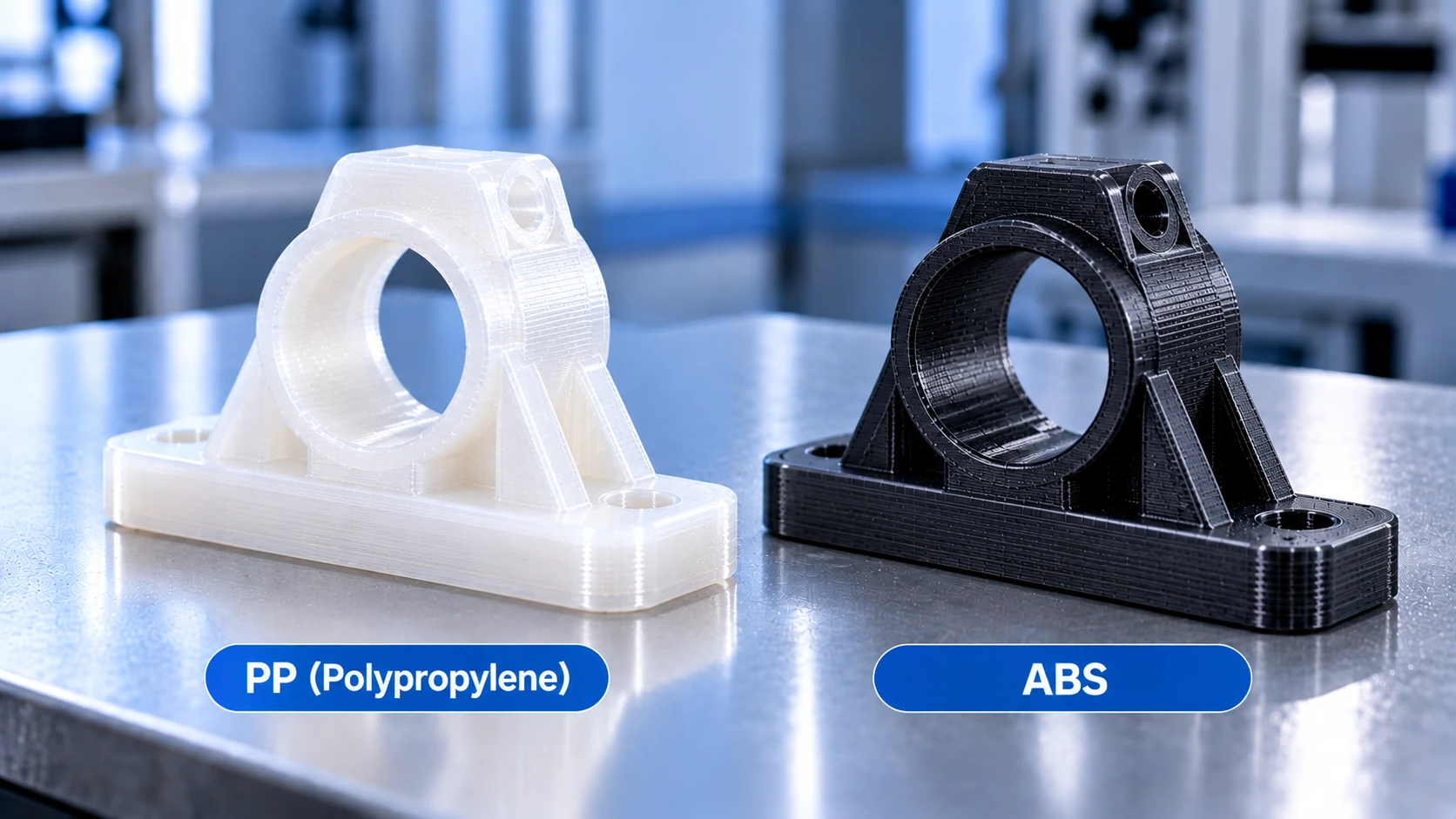
What’s the Difference Between PP and ABS? Performance and 3D Printing Difficulty Compared
What’s the Difference Between PP and ABS? Performance and 3D Printing Difficulty Compared
ABS is an engineering plastic that has been in use for many years and is known for its good rigidity, impact resistance, and well-established post-processing methods. PP (polypropylene), on the other hand, features low density and good chemical resistance; with appropriate structural design, it is also suitable for parts that require repeated bending. aa
The printing challenges for the two materials also differ. With ABS, it is typically necessary to focus on warping issues and pay attention to exhaust and ventilation during the printing process; with traditional PP, challenges such as poor bed adhesion and shrinkage control may arise. Understanding these differences helps in selecting materials based on actual applications, rather than making decisions based solely on preconceptions about the materials. Translated with DeepL.com (free version)
1. Material Properties: Two Different Options
ABS (acrylonitrile-butadiene-styrene) is an amorphous thermoplastic widely used for its rigidity, impact resistance, and well-established post-processing methods. Its typical density is approximately 1.04 g/cm³, though the exact value varies depending on the specific material grade.
PP (polypropylene) is a semi-crystalline polyolefin with a typical density of approximately 0.90 g/cm³. It offers resistance to a wide range of chemical substances and, when designed appropriately, can be used for structures that require repeated bending, such as living hinges.
Simply put, ABS is commonly used for rigid functional parts and enclosures, while PP is better suited for applications that require lightweight properties, chemical resistance, or the ability to withstand repeated bending.
There is no absolute superiority or inferiority between the two. The final choice depends on the material grade, part design, operating environment, and printing process.
2. Comparison of Printing Difficulty: PP vs. ABS
Warping and the Printing Environment
ABS can undergo significant shrinkage during the cooling process, making warping and edge lifting common printing issues. Many ABS printing setups utilize a heated bed and an enclosed print chamber to help manage temperature fluctuations during the printing process.
Conventional PP may also present challenges regarding shrinkage and adhesion; however, modified PP can offer improved printing performance through the optimization of material formulations.
For example, POLIVE PPpro™ does not require a heated bed or an enclosed print chamber. It can be printed at room temperature and supports open-door or open-lid operation. While an air-conditioned environment is ideal, it is not a strict requirement. The key principle during the printing process is to ensure uniform cooling.
These recommendations are specific to POLIVE PPpro™ and should not be applied directly to all PP filaments.
Depending on the part’s geometry and printer settings, auxiliary measures such as a “brim” (an extended attachment border) can sometimes improve print stability, though they are not necessary for every part.
Odors and Ventilation
Printing with ABS can produce a noticeable odor. Heating ABS may also release volatile compounds and ultrafine particles. In comparison, PP may produce a milder odor under certain printing conditions; however, the intensity of an odor is not a direct indicator of emission levels or the safety of a material.
Actual emission levels depend on factors such as material formulation, printing temperature, the printer, and the operating environment.
Regardless of the material used for indoor printing, ensure proper ventilation and follow the safety recommendations provided by the filament manufacturer. If you are sensitive to odors or need to print in a shared workspace, it is advisable to conduct a small-scale test in the intended environment first.
Platform attachment
Traditional PP has a low surface energy, making it difficult to form stable adhesion with certain printing platforms. Choosing the right filament formulation, printing surface, and operating settings can help improve this.
ABS is generally compatible with a variety of common print surfaces; however, actual adhesion depends on the specific printer, build plate, and printing conditions. Excessive adhesion can make it difficult to remove the finished part, so for both materials, it is important to consider platform compatibility and appropriate protective measures.
For POLIVE PPpro™, it is recommended to prioritize the specific printing guidelines provided for this material, rather than simply applying the standard heated-bed or build-plate preparation methods typically used for conventional PP.
Post-processing
ABS offers a variety of well-established post-processing methods. For instance, under controlled conditions, compatible ABS prints can be treated with acetone vapor to achieve a smoother surface. This process requires appropriate equipment, effective ventilation, and strict fire safety measures, as acetone is highly flammable.
PP exhibits good resistance to many chemical substances, which can make surface smoothing or coating using conventional solvents more challenging. For PP, mechanical sanding or surface treatments tailored to specific applications may be more practical.
The specific method to be used should be determined based on the desired appearance, the structure of the part, and the material formulation.
3. Comparison of Performance and Applications
Chemical resistance
PP generally exhibits resistance to a wide range of acids, bases, oils, and cleaning agents, making it a viable candidate for functional parts that may come into contact with specific chemicals or oily substances.
ABS can also withstand certain chemical substances, though its specific performance depends on the substance it comes into contact with and the conditions of use.
It should be noted that no single material can be considered resistant to all chemicals. When selecting a material, factors such as the type of chemical, concentration, temperature, duration of exposure, and mechanical stress must be taken into account. For applications requiring high reliability, printed parts should be tested in an environment that closely replicates actual usage conditions.
Heat resistance
Both PP and ABS can be used in functional applications that require exposure to relatively high temperatures, though actual performance depends on the specific grade and the testing conditions.
A material’s heat resistance cannot be determined solely by its melting point. Factors such as heat deflection temperature, long-term service temperature, applied load, and the duration of heat exposure are equally important.
Printed parts may deform under load, even at temperatures below their melting point. If a part is expected to come into contact with hot water, be placed near heating equipment, or be subjected to long-term thermal stress, please consult the technical data for the filament and verify performance within the actual operating environment.
Lightweighting
The density of PP is lower than that of ABS.
Taking the density of PP (approx. 0.90 g/cm³) and ABS (approx. 1.04 g/cm³) as a reference, for a given volume, a PP part will be approximately 13% lighter than an ABS part.
This is of value for weight-sensitive applications, such as portable devices, lightweight enclosures, and certain drone components.
However, the actual weight of a printed part is also influenced by wall thickness, infill density, internal structure, and the amount of material used. If more material is required to meet strength specifications, using a low-density material will not necessarily result in a lighter final part.
Fatigue resistance and repeated bending
A notable characteristic of PP is its suitability for structures subject to repeated bending. It is widely used for living hinges, flexible connection points, and certain types of snap-fit designs.
ABS offers good rigidity and impact resistance; however, its performance in scenarios involving repeated bending depends on the specific material grade, structural design, stress levels, and printing orientation.
If a part requires repeated opening and closing over a long period, factors such as hinge thickness, bend radius, print layer orientation, and the expected number of usage cycles should all be taken into account. Testing actual prototypes is the most reliable way to evaluate its durability.
Outdoor Weather Resistance
When exposed to ultraviolet (UV) radiation for extended periods, ABS may undergo discoloration, accompanied by changes in its mechanical properties. For outdoor applications, protective measures or materials specifically designed for outdoor environments may be required.
The outdoor weather resistance of PP also depends on its formulation, UV stabilizers, color, temperature, and exposure conditions. One should not assume that standard PP is suitable for long-term outdoor use.
If parts are to be exposed to the outdoors for an extended period, it is recommended—regardless of whether PP or ABS is chosen—to verify their long-term performance based on the actual environment.
4. How should one choose between PP and ABS?
In the following situations, PP may be considered as a priority option.
There are specific requirements regarding the weight of the parts.
The parts need to withstand specific greases, cleaning agents, or other chemical substances.
The structure needs to be capable of repeated bending, or it must incorporate living hinges.
Looking for material alternatives to ABS for certain functional applications
It has been confirmed that the selected PP filament can consistently produce parts that meet the requirements.
ABS may be a preferred option in the following situations:
It is necessary to produce functional parts or enclosures that possess a certain degree of rigidity.
The mechanical properties and heat resistance of ABS are sufficient to meet practical requirements.
We intend to employ established post-processing methods, such as acetone vapor smoothing for applicable parts.
The printing equipment and work environment are capable of meeting the operational requirements for ABS printing, and printing emissions are properly managed.
Still not sure?
It is recommended to print a small test specimen for each material and compare them under identical application conditions. Focus the evaluation on weight, rigidity, impact resistance, changes following chemical exposure, dimensional stability, and surface quality.
If you are particularly concerned about odors, you should focus on ventilation and emission control, rather than relying solely on the smell to determine which material is safer.
5. Conclusion
PP and ABS each have their own advantages.
ABS: Its advantages lie in its rigidity, impact resistance, and well-established post-processing methods.
PP: Its advantages include a lightweight nature, resistance to a wide range of chemicals, and—when properly designed—the ability to withstand repeated bending.
The two materials present different printing challenges. With ABS, the primary concerns are typically warping and printing emissions, while traditional PP often poses difficulties related to bed adhesion and shrinkage. Modified PP filaments, such as POLIVE PPpro™, are designed to improve the printing experience by optimizing both the material formulation and the corresponding printing parameters.
If you are looking for an alternative to ABS for functional parts that require lightweight properties, chemical resistance, or the ability to withstand repeated bending, consider evaluating POLIVE PPpro™. The final choice should always be based on the specific requirements of your application and the test results of the printed parts.
PP 和 ABS 主要差在哪?
ABS 刚性好、耐热、后处理成熟,但打印气味和翘边明显;PP 更轻、耐化学和抗疲劳更好、韧性强,室内打印气味更温和。
打印难度上两者各有什么问题?
ABS 怕翘边、怕通风、常要封箱;PP 过去难在收缩和首层粘附。现在改性 PP 走的是另一条路:不加热床、不封箱,靠开放散热和专用胶水解决。
到底该选哪一个?
要刚性、耐热和成熟后处理,选 ABS;要轻、耐化学、耐弯折、室内气味轻的功能件,选 PP。别只比谁更好打。
Related Reading
Is PP safer than ABS? 3D printing analysis of indoor air quality
How Much Temperature Can PP Prints Withstand? PP’s Heat-Resistance Performance
Are PP 3D-printed parts drop-resistant? A comparison of impact resistance: PP vs. PETG and ABS