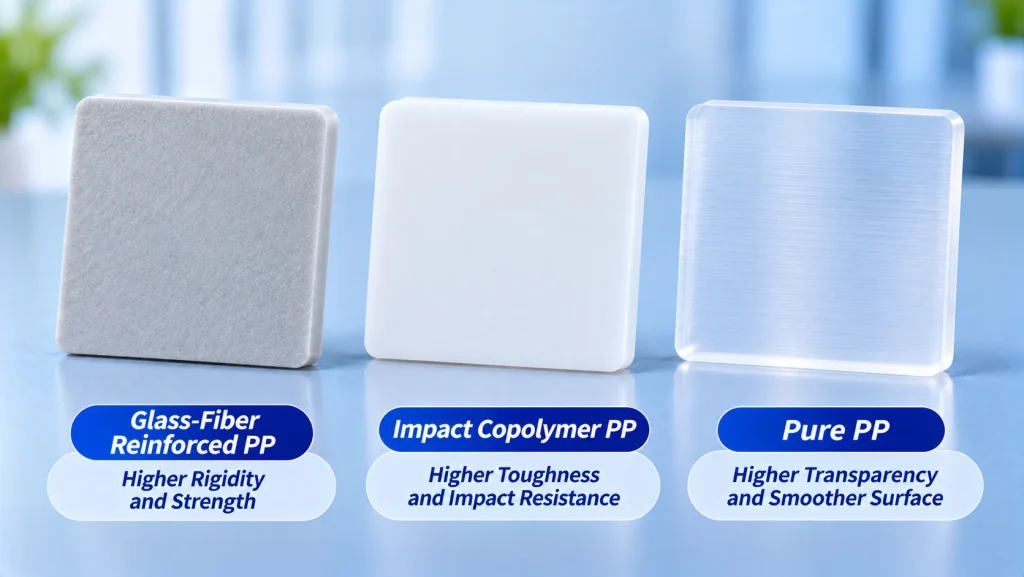
Modified PP: What Are Glass Fibre Reinforcement and Impact Copolymers For?
Neat PP is cheap and easy to use, but it has shortcomings in stiffness and low-temperature toughness. Hence modified PP: small additions or structural design shift PP to where a particular application needs it.
The two most common routes are glass fibre reinforcement and impact copolymerisation. They solve different problems and come with different trade-offs.
Glass Fibre Reinforced PP: More Stiffness, More Heat Resistance, Less Shrinkage
Adding glass fibres to PP has one immediate effect: stiffness and strength go up.
Research data show that as glass fibre content rises, PP's tensile and flexural moduli rise with it. One experiment found that a composite with 40% glass fibre gained about 91% in tensile strength and about 62% in flexural strength. Heat resistance improves too, shrinkage falls and dimensional stability gets better.
The trade-offs are just as clear. With glass fibre added, PP loses toughness and gains brittleness. The surface becomes rougher and fibres can show as specks on the part. For injection moulding equipment, the hardness of the fibre plus volatilisation of additives at high temperature means more wear and corrosion on screws and moulds.
Glass fibre reinforced PP is common in automotive parts, structural components of appliances and power tool housings. These applications want stiffness and heat resistance and care little about surface finish or toughness.
Impact Copolymer PP: Taking the Brittle Out of the Cold
Impact copolymer PP takes a different route. Ethylene segments are introduced during polymerisation, and these soft segments absorb impact so the material is less likely to fracture in the cold.
This is similar in thinking to "adding rubber" — both rely on an elastomer phase for toughening. Commercial impact copolymer grades are explicitly labelled as having "excellent impact resistance even at low temperatures", with applications including cold-storage drums, crates and industrial containers as well as automotive interior parts. Patent data show that some impact copolymer PP grades reach a notched impact strength of 5.3 kJ/m² at -20°C.
This closes exactly the low-temperature gap of neat PP. Standard PP starts losing toughness around 0°C; impact copolymerisation pushes that lower limit down a notch.
Other Modification Routes: Talc, Flame Retardancy, Weatherability
Beyond these two main routes, there are several other common modification directions.
Adding Talc: Raises stiffness and heat resistance, reduces shrinkage and costs little. Widely used in structural parts of appliances.
Adding Flame Retardants: For electrical and electronic parts that need to meet a V-0 or V-2 flame retardancy rating.
Adding Light Stabilisers and Antioxidants: For outdoor products, resisting UV and thermo-oxidative ageing. As mentioned in the previous article on PP's weak spots, a single additive is not enough — a synergistic package is needed.
The logic is the same in every case: small additions or structural design shift PP to where a particular application needs it.
What Do These Modification Routes Have to Do with PPpro?
One thing needs stating clearly: PPpro modified PP 3D printing filament follows neither glass fibre reinforcement nor impact copolymerisation.
Glass fibre reinforced PP is difficult to handle in FDM printing. The fibres wear the nozzle, prints come out rough and interlayer bonding is harder to control. The low-temperature toughness of impact copolymer PP is not the first priority for functional 3D printed parts used at room temperature.
PPpro has a different modification goal: it tackles the poor adhesion and severe warping of conventional PP in FDM printing. It keeps PP's light weight, chemical resistance and ability to bend repeatedly, while optimising bed adhesion and interlayer bonding — the no heated bed, no enclosure, print with the lid open route.
So when choosing a material, first be clear about what your part lacks: stiffness (consider glass fibre reinforcement), low-temperature toughness (consider impact copolymer) or printability (consider PPpro). The three modification routes solve three different problems and cannot substitute for one another.
Conclusion
Glass fibre reinforced PP addresses stiffness and heat resistance at the cost of toughness, surface finish and equipment wear. Impact copolymer PP addresses low-temperature brittleness, using ethylene segments to absorb impact, and is common in cold storage and automotive applications. Talc, flame retardancy and weatherability are more specialised routes.
Ask about service temperature, loading mode and required lifetime first, then decide whether to modify and in which direction. PPpro follows the printability route, not the glass fibre or impact route; the three each mind their own business.
Common Questions
Can Glass Fibre Reinforced PP Be 3D Printed?
Technically yes, but rarely in practice. The fibres wear the nozzle, prints are rough and interlayer bonding is hard to control. Glass-fibre-filled materials for FDM demand a lot from equipment and process settings and are not a routine choice for ordinary printers.
Is Impact Copolymer PP the Same as Adding Rubber?
Similar in idea, different in execution. Impact copolymerisation introduces ethylene segments during polymerisation to form an elastomer phase that absorbs impact; adding rubber is physical blending. Both aim at toughening, but the copolymer has a more uniform phase structure while being less flexible than blending.
Is PPpro Glass Fibre Reinforced or an Impact Copolymer?
Neither. PPpro is modified to solve PP's adhesion and warping problems in FDM printing, keeping PP's nature while optimising printability. It is neither glass fibre reinforced nor an impact copolymer — do not mix them up when choosing a material.