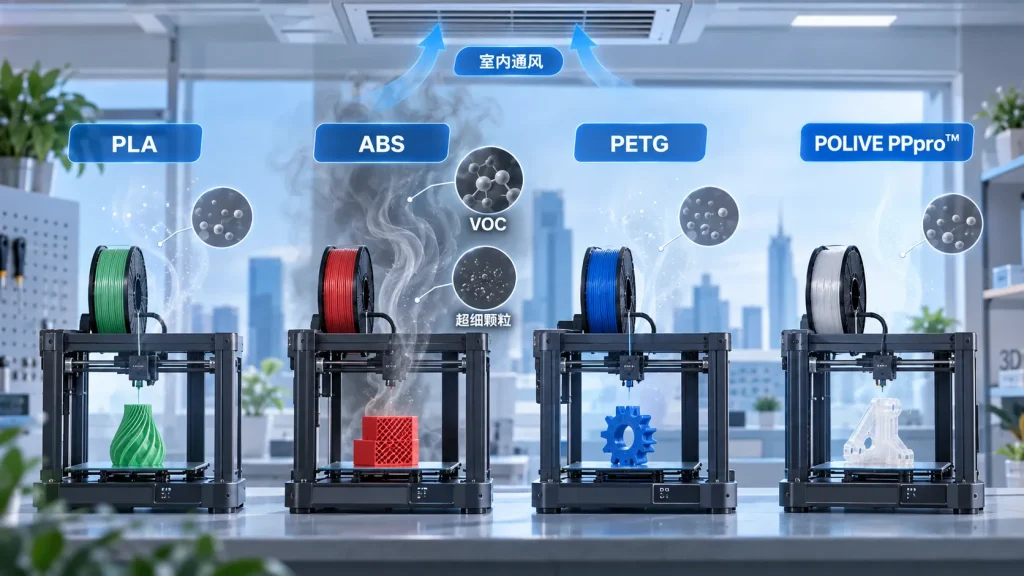
3D printing has a smell, is it really just “plastic smell”?
Many 3D printing users have become accustomed to the special smells that appear when printing.
However, it is important to note that:
Odor does not directly determine whether a material is safe, nor can it be proven that there is no VOC by “smelling tasteless”.
During FDM 3D printing, polymers can produce volatile organic compounds (VOCs) as well as ultrafine particles when heated to melt. Different materials, brands, colors, additives, nozzle temperatures and printing equipment can all affect the final emissions.
Therefore, if the printer stays in the bedroom, study, classroom, or other people’s space for a long time, the problem of printing material emissions deserves serious consideration.
What is the difference between the smells of different 3D printed materials?
PLA: Odor is generally lighter but does not mean “no emissions at all”
PLA printing usually does not produce a pungent odor as pronounced as ABS.
However, studies have shown that PLA can also release VOCs and ultrafine particles during heating printing, but specific emissions and emissions are affected by factors such as material formulation, brand, color, and printing conditions.
So, rather than saying “PLA is harmless,” it’s more accurate to say:
Different PLA products have different emission characteristics, and their air quality performance cannot be judged by smell alone.
ABS: Styrene is one of the emissions that needs attention
ABS is a material that is often discussed in 3D printed emission studies.
Several studies have found that VOCs such as styrene, which is an important component of ABS emissions, can be detected during ABS printing.
More notably, the International Agency for Research on Cancer (IARC) currently classifies styrene as Group 2A – probably carcinogenic to humans.
This does not mean that “printing ABS once will cause health hazards”, the actual exposure risk also depends on factors such as printing time, material, printing temperature, space size, ventilation conditions, etc.
But it illustrates a point:
Long-term printing of ABS in indoor environments with limited ventilation is indeed worth paying attention to air quality and exposure control.
What about PETG?
PETG generally has a lighter odor than ABS, but “light odor” does not equate to “no VOC”.
Studies have shown that VOC emissions can vary significantly across materials, and that there can be differences between brands of the same material. In some studies, VOC emissions of PETG were significantly lower than those of ABS, but volatile substances were still detected.
Therefore, when selecting materials, it is not easy to judge by “whether there is a taste or not”.
What does PPpro™ look like when printed?
PPpro™ is a modified PP filament developed by POLIVE for FDM 3D printing.
In our actual print experience,PPpro™ prints with a low odor and usually no noticeable pungent odor.
However, special instructions are needed:
“Low odor” does not mean “zero VOC”, nor can it be judged by odor alone that the material is completely free of emissions.
Rigorous air quality comparisons of different materials require VOC and particulate matter testing in a uniform printer, temperature, print speed, material usage, and test environment.
This is why POLIVE focuses not only on print stability, but also on the experience of the material in the actual use environment during the product development process.
Why is the print environment still important?
Regardless of which type of FDM filament is used, it is recommended to maintain reasonable ventilation.
in particular, in such areas as
- BEDROOM
- Study
- Classroom
- Workspace
- Small studio
In the environment where people stay for a long time, the location of air exchange and printing equipment should be considered.
A study of the office environment found that in large, well-ventilated spaces, a single print had a relatively limited effect on the concentration of VOCs and ultrafine particles in the air, while in smaller, poorly ventilated spaces, the associated emissions were more easily detected.
So the more important question than simply asking “which material doesn’t taste” is actually:
What is the material + what is the print temperature + how large is the print space + what are the ventilation conditions?
Low odor is one of the benefits of PPpro™
For people who need to use 3D printers for a long time, smell is indeed one of the factors that can be considered when choosing materials.
POLIVE PPpro™ is designed with a focus not only on the low density, toughness and chemical resistance of PP, but also on making the practical use of PP in FDM printing more user-friendly.
If you’re looking to try PP on a common FDM device while focusing on odor and experience during printing, PPpro™ is an option worth testing.
But whether PP, PLA, PETG or ABS is used, proper ventilation is still the more important basic measure.
Related Reading: What is the difference in indoor air quality between PP and ABS?
More PPpro™ product information:polive3d.com
3D 打印那股味,只是塑料味吗?
不只是。不同材料加热释放的挥发物不一样,ABS 会释放苯乙烯,PP 的排放构成和它不同;气味是提示,但闻不到也不代表没有挥发物。
PETG、PP 这些材料的气味差别大吗?
主观感受上 PP 通常更轻,PPpro™ 在室内打印的气味表现也比较温和;但气味强弱不能直接换算成 VOC 高低,要靠检测才算数。
用 PPpro™ 打印时怎么安排环境更合适?
保持房间正常通风、避免密闭小空间长时间连打。我们本身建议开放打印:不加热床、不封箱,空调房里开门开盖更利于 PP 散热定型,空气也更容易交换。