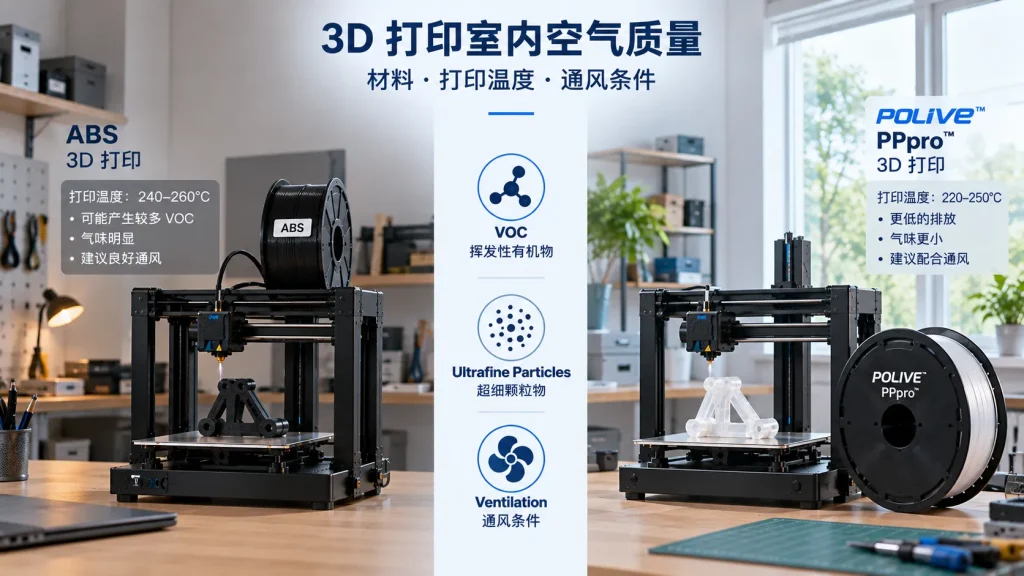
How Does Indoor Air Differ When Printing with PP vs. ABS?
Many desktop 3D printers are placed in homes, offices, classrooms and studios.
But during FDM 3D printing, the filament must be heated and extruded, and this process can release into the surrounding airvolatile organic compounds (VOCs) and ultrafine particles. NIOSH research also shows that emissions during 3D printing are affected by factors such as print material, color, printer and usage environment.
Therefore, when comparing PP and ABS, you cannot simply define one material as “safe” and the other as “unsafe.”
A more reasonable approach is to understand:
what different materials may release during printing, and how the actual usage environment affects exposure.
ABS 3D Printing Releases Styrene
ABS is a copolymer made up of acrylonitrile, butadiene and styrene-related components.
During FDM 3D printing, studies have detectedstyrene and other VOCs. NIOSH-related studies also list styrene as one of the substances of concern in ABS 3D printing emissions.
After re-evaluating styrene in 2019, the International Agency for Research on Cancer (IARC) classified it as:
Group 2A — probably carcinogenic to humans.
It is important to note that the IARC classification describesthe carcinogenic hazard of styrene itself, and cannot be directly equated with the specific health risk posed by any single 3D printing session.
Actual exposure also depends on:
- Styrene concentration
- Print duration
- Number of printers
- Room size
- Ventilation conditions
- Distance from the printer
Therefore, when ABS is used indoors, especially in small or poorly ventilated spaces, greater attention should be paid to ventilation and emission control.
PP 3D Printing Also Produces Emissions
PP cannot simply be understood as “having no VOCs at all.”
Like other thermoplastics, PP can also produce VOCs and particles during high-temperature extrusion.
Moreover, for 3D printing materials,the specific formulation matters a great deal.
Beyond the base polymer, color, additives and processing formulation can all affect final emission performance. NIOSH also points out that both filament material and color affect VOC emissions during 3D printing.
Therefore, you cannot conclude based solely on:
PP’s chemical formula is (C₃H₆)n
that “PP printing produces almost no VOCs.”
Does no smell mean VOCs are low?
Not necessarily.
Smell does not accurately represent VOC emission levels.
Different chemicals have different odor thresholds: some substances can produce a noticeable smell even at very low concentrations, while others may be hard to detect.
Therefore:
Low odor ≠ zero VOCs
Likewise:
An odor ≠ necessarily a hazardous concentration
For 3D printing filaments, truly comparing emission levels requires measurement under defined printing conditions, not judgment by the human sense of smell alone.
PP vs. ABS: Which Has Lower Emissions?
Existing research shows thatthere are clear differences in VOC and particle emissions between different FDM printing materials.
Styrene and other VOCs can be detected during ABS printing, and emission levels also vary between different materials, print temperatures and printing devices.
Therefore, the more accurate statement is not:
“All PP has lower VOCs than ABS.”
Instead, it is:
The emission performance of a specific filament needs to be judged in light of its material formulation and actual printing conditions.
For users, when choosing a material, in addition to mechanical properties and print difficulty, it is also worth checking whether the manufacturer provides actual emission test information.
PPpro™’s Indoor Printing Performance
PPpro™ is a material-modified PP 3D printing filament whose development focus is improving the printing performance of conventional PP in FDM 3D printing.
In actual printing, PPpro™’s odor is relatively mild.
But it must be stressed that:
Odor cannot be used as a basis for judging VOC emission levels.
Actual emissions are still affected by factors such as print temperature, printer, material formulation and ventilation conditions.
Therefore, when using PPpro™ for 3D printing indoors, it is still recommended to maintain adequate air circulation and to arrange printing equipment sensibly according to the actual usage environment.
3D Printing Requires Attention to More Than VOCs
Many people, when discussing indoor 3D printing, focus only on VOCs.
In fact, 3D printing can also produceultrafine particles (UFP).
NIOSH research and safety guidelines both note that FDM 3D printing can produce VOCs, semi-volatile organic compounds and ultrafine particles, so ventilation, local exhaust or appropriate filtration are common ways to reduce exposure.
Therefore, even if a filament has a low odor, it does not mean air circulation can be ignored entirely during printing.
Which environments warrant greater attention to indoor air quality?
If a 3D printer is used in the following environments, air quality during printing deserves particular attention:
- Bedrooms or living spaces
- Classroom
- Offices
- Small studio
- Environments with long, continuous printing
- Rooms with limited ventilation
Especially in small spaces, during long print jobs, or when multiple printers run simultaneously, ventilation and emission control deserve greater attention.
PP’s Advantages Go Beyond Low Odor
For 3D printing, PP’s value is not solely about its odor during printing.
PP itself has material properties suited to functional parts, such as:
- low density
- Low water absorption
- good chemical resistance
- flexibility
- good fatigue resistance
PPpro™’s development direction is to make these PP material properties easier to apply to real parts via FDM 3D printing.
Therefore, when choosing a 3D printing material, two questions can be considered separately:
The performance of the material itself
and
emission performance during printing
The two are not the same concept.
How to Reduce Exposure When Printing Indoors?
Whether using PP, ABS or other thermoplastic filaments, a sensible printing environment matters.
Consider the following:
- Maintain good indoor ventilation
- Avoid placing the printer in bedrooms or next to places where people stay for long periods
- Consider local exhaust during long print jobs
- Follow the usage recommendations of the printer and filament manufacturers
- Pay extra attention to air circulation when multiple printers run at once
NIOSH also recommends engineering controls such as ventilation, local exhaust and appropriate filtration to reduce emission exposure during 3D printing.
Summary
ABS 3D printing can produce styrene and other VOCs, and research has shown clear differences in emissions between different 3D printing materials. IARC currently classifies styrene as Group 2A, i.e., probably carcinogenic to humans.
PP likewise cannot simply be described as “having no VOCs at all” or “absolutely safe for indoor printing.”
Actual emissions depend onmaterial formulation, print temperature, printer, print duration and ventilation conditionsare all related.
For PPpro™, what we care more about is:
making PP easier to use in FDM 3D printing while retaining the valuable material properties that PP itself has.
If you care about the indoor printing environment, rather than simply comparing “whether there is a smell,” it is better to also considerthe material, printing conditions and ventilation environment.
PP 打印时比 ABS 更安全吗?
就气味和排放而言,ABS 打印会释放苯乙烯,PP 的排放表现相对更温和,桌面环境更容易接受。但安全不等于零排放,任何热塑性材料加热都会有挥发物。
没味道就等于 VOC 低吗?
不等于。气味是主观感受,VOC 要看实际检测;有些挥发物闻不到也仍需通风。别用鼻子当检测仪器。
在家或教室打印,怎么降低空气影响?
保持房间通风、避免长时间密闭连续打印、机器别贴着人放。PPpro™ 本身按不封箱设计,开门开盖在空调房里打印既利于 PP 散热,也便于空气交换。