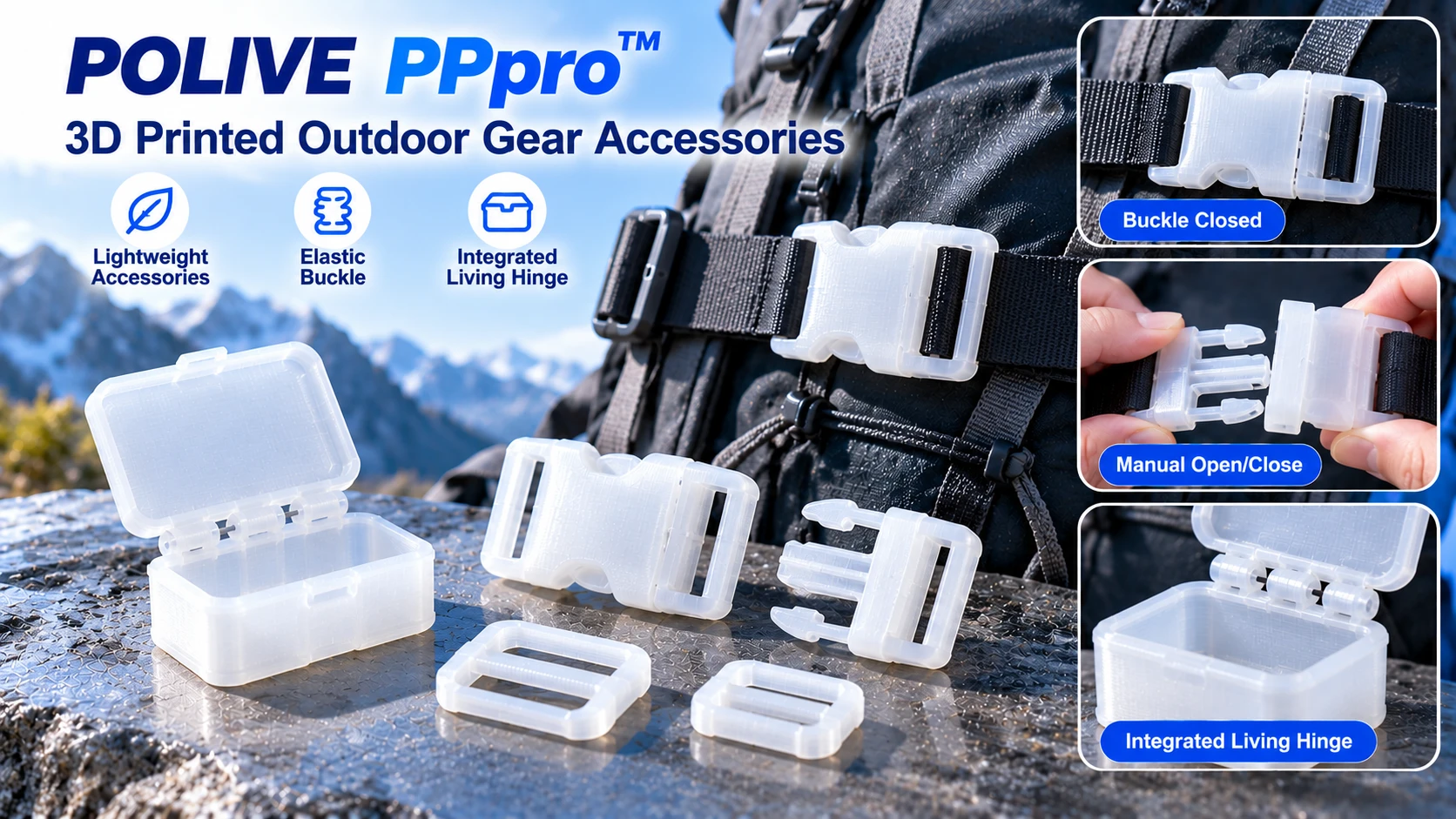
Can 3D Printing Make Sports and Outdoor Gear Accessories? PP’s Fatigue Resistance in Action
Yes. Snap fits, strap buckles and folding structures are directions worth trying first. Backpack buckles, strap adjusters, gear brackets and folding storage accessories share the same requirements: customised structure, light weight and repeated operation.
PP (polypropylene) offers good toughness and some fatigue-resistance potential, with a typical density of about 0.90 g/cm³. Using it to evaluate lightweight functional parts that bend repeatedly is reasonable.
With flexible arms, movable joints and load-bearing structures designed correctly, PP has plenty to offer in sports and outdoor gear. Of course, the actual performance of each part depends on the material, the structure, the print orientation and the conditions of use.
1. What Do Sports and Outdoor Gear Accessories Demand?
Repeated Opening, Closing and Bending
Backpack buckles, strap adjusters and folding storage accessories are opened and closed every day. A part must not only clip in and release, but also keep its shape and function after repeated use.
PP’s toughness makes it a candidate for material evaluation in such structures. The length, thickness and bend region of the flexible arm can be tuned, and the operating feel and deformation behaviour of the buckle change accordingly.
Lightweighting
Hiking, cycling and camping gear needs to be both functional and light. With a typical density of about 0.90 g/cm³, PP has advantages for lightweight buckles, brackets and storage accessories.
The final weight also depends on part size, wall thickness and internal structure. With ribs and load-bearing areas arranged sensibly, functionality can be kept while material is saved.
Moisture and Chemical Resistance
Outdoor gear encounters sweat, mud, rain and cleaning agents. PP has low water absorption and resists many common chemical media.
For accessories that will contact specific cleaning agents or other chemicals, the material must be selected according to the actual medium, concentration and contact time.
Vibration and Mechanical Impact
Outdoor gear is continuously vibrated, dropped and knocked. The performance of buckles, brackets and connectors depends not only on material toughness but also on part geometry, connection method and load direction.
For accessories that carry heavy loads, structural design is just as important as the actual conditions of use.
2. PP’s Fatigue Resistance and Living Hinge Advantages
Structures Suited to Repeated Bending
PP is commonly used in plastic structures that bend repeatedly, such as certain elastic snap fits and living hinges.
A living hinge connects two relatively moving parts through a thin flexible section, eliminating the separate parts of a conventional hinge. Storage boxes, flip lids and small gear accessories designed as one piece are also easier to assemble.
However, how many bending cycles a living hinge survives depends on material formulation, hinge thickness, bend radius, print orientation and range of operation. With the same PP material, different structures can vary greatly in flex life. For a specific count, it is best to print samples of your own structure and test them.
Structural Design of Elastic Snap Fits
A snap fit relies on the elastic arm deforming to complete engagement and release.
Several parameters can be tuned during design:
- Flexible arm length: affects the deformation space and the operating feel.
- Flexible arm thickness: affects stiffness and the strain during bending.
- Root fillet: helps reduce local stress concentration.
- Hook and mating clearance: affects engagement resistance, retention force and ease of removal.
These parameters must be tuned for the specific geometry. A flexible arm that is too short or too thick may require excessive operating force; an unsuitable clearance can also compromise the engagement.
How to Evaluate Repeated Opening and Closing?
For a newly designed snap fit or living hinge, the initial engagement force, release force, dimensional changes and condition after repeated operation can be recorded.
To compare different structures, keep the material and print settings identical and vary only one main design parameter. That way the effect of the structural change becomes clear.
This method also applies to developing snap-fit and living-hinge samples with POLIVE PPpro™, allowing the structure to be optimised step by step and the operating feel to be adjusted incrementally.
3. Design and Printing Essentials for Sports and Outdoor Accessories
Add Fillets at the Root of Flexible Arms
The root of a flexible arm is where bending deformation concentrates. A suitable fillet reduces the stress concentration caused by sharp corners.
How large the fillet should be depends on the arm thickness and the overall geometry — bigger is not always better.
Arrange Print Orientation Sensibly
The mechanical properties of FDM prints are direction-dependent; layer bonding affects a part’s bending and tensile behaviour.
When designing, arrange the print orientation according to the bending direction of the flexible arm, so that critical load-bearing areas do not rely too much on the weaker layer bonding.
For living hinges and snap fits, print small samples first to observe the bend location, layer-line direction and actual operating feel, then optimise the full part.
Optimise Wall Thickness and Fit Tolerances
Snap hooks, racks and mating faces need reasonable fit clearance. Too small and assembly is difficult; too large and the engagement is unstable.
It is recommended to first print sample pieces of the local structure, measure the actual dimensions and test the engagement, then finalise the model.
Suitable fit dimensions may differ across printers, part sizes and structure types.
Design Buckles Around the Actual Application
Testing the buckle body alone does not necessarily reflect how it performs within the complete gear.
For example, a backpack buckle in use is also affected by strap width, webbing thickness, stitching position and the direction of pull. So the design should be evaluated together with the complete mating structure whenever possible.
Printing Characteristics of POLIVE PPpro™
POLIVE PPpro™ needs no heated bed and prints at room temperature, with the door open or the lid open. An air-conditioned room is better but not a hard requirement. Even cooling during printing is the key.
When making sports and outdoor accessories, print orientation, wall thickness and related parameters can be tuned according to part shape, flexible structure and assembly requirements.
4. Which Sports and Outdoor Accessories Are Worth Exploring First?
Backpack Buckles and Strap Adjusters
Backpack buckles and strap adjusters have clear structural requirements and suit 3D printing for tuning dimensions, engagement style and mounting position.
Buckle bodies can be designed for different webbing widths, with hook shapes and flexible-arm parameters varied to try out different operating feels.
Folding Storage Accessories
Folding boxes, flip lids and one-piece movable joint structures can be custom-designed with 3D printing.
For regions that bend repeatedly, focus on tuning the thickness, width and bend radius of the flexible section to better match the specific opening and closing motion.
Outdoor Gear Brackets
Flashlight holders, cable clips and storage accessories can be given dedicated mounting structures designed around the actual gear dimensions.
PP’s low density aids lightweighting, while 3D printing makes mounting holes, snap fits and support structures easier to adapt to different gear.
Protective Covers and Storage Attachments
Accessories for protecting small devices, organising cables or storing tools can be given customised external shapes and internal structures through 3D printing.
These parts can also be given anti-slip textures, hanging holes and locating features for greater convenience.
One reminder: climbing anchor points, harness buckles and load-bearing hanging parts — components directly related to personal safety — must not be judged suitable based on the material properties of ordinary prints alone. Such equipment must follow the relevant design, testing and certification requirements.
5. How to Improve the Real-World Performance of PP Sports and Outdoor Accessories?
Optimise the Structure Starting from Local Samples
For flexible arms, living hinges and snap fits, local structures can be printed first to compare the operating feel of different thicknesses, lengths and fillet designs.
This reduces the number of full-model revisions and makes it easier to identify the key parameters affecting deformation and engagement.
Watch for Changes After Repeated Operation
For parts opened and closed frequently, the engagement force, deformation and surface condition can be recorded at different stages of operation.
Checking whether the snap fit has loosened, whether the flexible arm has cracks and whether dimensions have changed noticeably makes the structure’s behaviour under repeated use clear.
Assemble with Real Gear
Combining the printed part with webbing, screws, brackets or other mating parts reveals how convenient the actual assembly is and how it feels in use.
For different gear models, hole positions, snap-fit dimensions and connection methods can be adjusted to create designs better suited to the specific application.
6. Summary
PP 3D printing adds a design option for customised sports and outdoor gear accessories. Snap fits, movable joints and lightweight storage structures are especially worth trying first.
- Typical Applications: backpack buckles, strap adjusters, folding boxes, gear brackets and cable clips.
- Material Properties: PP offers good toughness and low density, with potential for some repeatedly bending structures.
- Design Priorities: flexible arm length and thickness, root fillets, print orientation and fit tolerances.
- Development Method: optimise the local structure first, then evaluate assembly and operating performance with the complete accessory.
- Application Selection: choose suitable structural and material solutions based on part load, frequency of use and actual function.
To develop lightweight, customisable sports and outdoor gear accessories, POLIVE PPpro™ can be used to trial different snap fits, living hinges and functional structures.
Related Reading
- Can PP Make Living Hinges? Printing One-Piece Living Hinges with POLIVE PPpro™
- Are PP 3D-printed parts drop-resistant? A comparison of impact resistance: PP vs. PETG and ABS
- How Long Do PP Prints Last? Ageing and Service Life of PP
- Why Is PP Density Only About 0.90 g/cm³? A 3D Printing Material Lighter Than Water
- How to Design PP Parts for 3D Printing? Wall Thickness, Fillets, Snap Fits and Warp Prevention
运动和户外配件适合用 PP 吗?
适合。卡扣、织带扣、折叠结构最值得先试:背包扣、织带调节件、装备支架、折叠收纳件,都吃 PP 的抗疲劳和韧性。
PP 的抗疲劳优势体现在哪?
反复开合、弯折、扣合时不易脆断,一体式活铰链能做进零件里,比装金属件或多件拼接更轻、更少故障点。
这类件设计和打印要注意什么?
弯折区留足厚度和弯曲半径、圆角过渡、避免壁厚突变;打印不加热床、不封箱,开放散热,首层用裙边加 PPLOCK26811。
户外用还要补什么?
紫外线是 PP 的短板,长期直晒要加遮挡或防护;另外按真实开合次数和低温条件做验证,低温下韧性会下降。