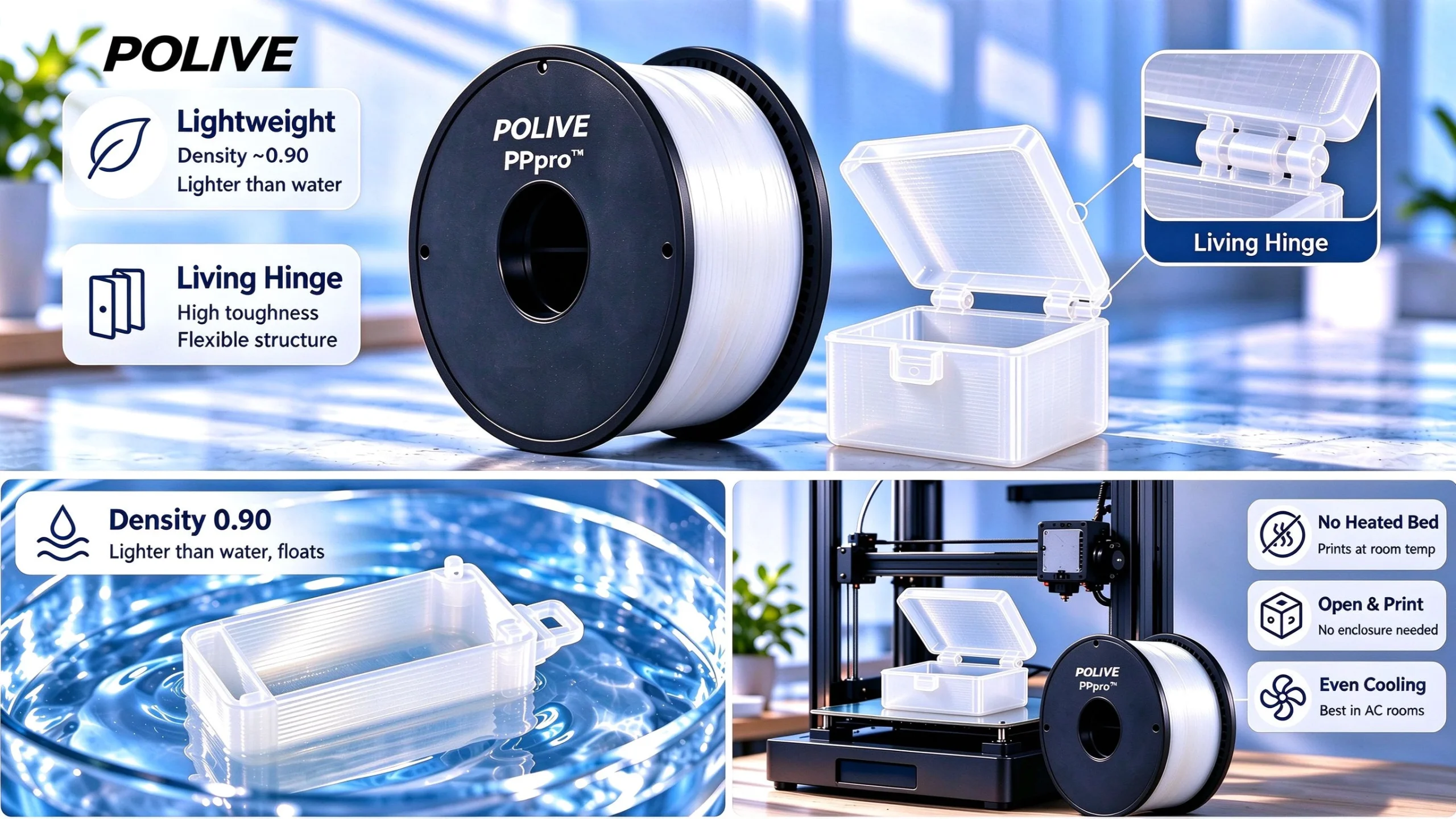
What Is PPpro? A Modified PP 3D Printing Filament That Needs No Heated Bed and Makes Living Hinges
PPpro is modified PP that prints without a heated bed or enclosure, holds a living hinge and resists chemicals: made for functional parts.
PP is one of the lightest commodity plastics in common use, with a density of about 0.90 g/cm³âlighter than water and 27% lighter than PLA. Its saturated hydrocarbon backbone resists most acids and alkalis, and it can be bent repeatedly without easily breaking. Lightness, chemical resistance, and living-hinge capabilityâthese three are exactly the properties that functional 3D-printed parts most lack.
The problem is that PP used to be hard to print. It needed a heated bed, an enclosure, and PP-specific tape, and the slightest oversight caused warping and cracking.
POLIVE PPpro⢠was created to resolve this contradiction. It is a modified PP 3D printing filament aimed at functional parts. Its goal is not to produce yet another harder-to-print PP, but to make PP’s capabilities truly manufacturable at scale. In terms of process, it prints without a heated bed or enclosure and with the lid open, and performs even better in an air-conditioned room.
What PPpro Changed
The printing conditions were relaxed. Filament diameter is 1.75 mm, nozzle temperature 200â220 °C, and a bed temperature of 25â40 °C (room temperature) is enough. No enclosure, open-lid printing. Most PP filaments on the market require a heated bed at 80â100 °C, an enclosure, and PP tapeâthis is exactly where PPpro differentiates itself.
Its material nature was preserved. Density is about 0.90 g/cm³, 27% lighter than PLA; it resists most acids and alkalis; and it can be bent repeatedly, making it suitable for living hinges. These are not achieved by piling on parametersâthey are PP’s inherent foundation.
The raw material is traceable. PPpro’s filament raw material is certified under a chemical-recycling (ISCC PLUS) scheme, and material-level traceability documents can be provided per order. This is something imported PP filaments generally cannot offer.
Which Scenarios Is It Suited For
PPpro’s main arena is nine types of applications:
Living hinge
Buoyant parts
Acid/alkali-resistant parts
Airborne weight reduction (drones, model aircraft)
Pet safety products
Household teaching aids
Medical and elder-care aids (non-devices)
Food contact (certification in progress, not yet promoted as a selling point)
Heat-resistant parts (boiling-water-disinfection grade)
Every scenario relies on PP’s true nature. When selecting a material, first see whether your part needs these capabilities, then judge whether PPpro fits.
How to Get Started
We recommend starting with a 10 m sample. Use your own printer to validate the parameters, print an actual part, and confirm the feel and performance meet expectations before deciding between a 250 m or 400 m spool.
Match the material’s nature against your part, and you can quickly tell whether PP is the missing piece of the puzzle.
Conclusion
PPpro resolves PP's long-standing contradiction in 3D printingâ'great performance but hard to print': it keeps the real strengths of lightness, chemical resistance, and living-hinge capability, while lowering printing conditions to a room-temperature bed, no enclosure, and open-lid printing. For developers of functional parts, it offers a PP solution that can be manufactured stably at scale, rather than yet another material that demands careful coddling.
Common Questions
Does PPpro Really Need No Heated Bed?
Yesâbed temperature of 25â40 °C (room temperature) is enough. The key is even cooling without direct drafts. This is also what fundamentally sets it apart from most PP filaments.
What Is the Relationship Between PPpro and Chemical Recycling?
The filament raw material used in PPpro is certified under a chemical-recycling (ISCC PLUS) scheme. Material-level traceability documents can be provided per order.
What Is PPpro™?
A modified PP 3D printing filament designed to overcome the three hurdles PP faces in FDM at once — shrinkage and warping, first-layer adhesion, and layer bonding — while keeping PP's inherent lightness, chemical resistance, fatigue resistance and ability to form living hinges.
Does It Really Need Neither a Heated Bed nor an Enclosure?
Yes. In practice we print with no heat and no enclosure. As PP cools it has to absorb and shed a great deal of heat, and in an air-conditioned room, printing with the door and lid open on an open-frame machine dissipates heat faster — better for the part to set than trapping that heat inside a chamber.
Without a Heated Bed, How Does the First Layer Stick?
Apply a thin coat of PPLOCK26811 adhesive, let it dry for a few minutes and print directly on it, with a brim for support. One application lasts for multiple prints, and cleaning is just a wipe with alcohol.
With No Heat and No Enclosure, How Is Warping Handled with PPpro™?
On the design side: replace right-angle corners with rounded fillets, add thickened mouse ears at the base, enlarge the bottom contact area and keep wall thickness uniform. On the plate side: adhesive plus a brim. Doing both works better than adjusting temperatures.
Can an Entry-Level Open-Frame Machine Print It, and Which Parts Is It Suited To?
Yes — we have printed many models on a Bambu A1. It is well suited to containers, snap-fits, living hinges, lightweight structural parts, parts exposed to water, and functional components that need chemical and fatigue resistance.