PP’s Molecular Structure: Why It Consists Only of Carbon and Hydrogen
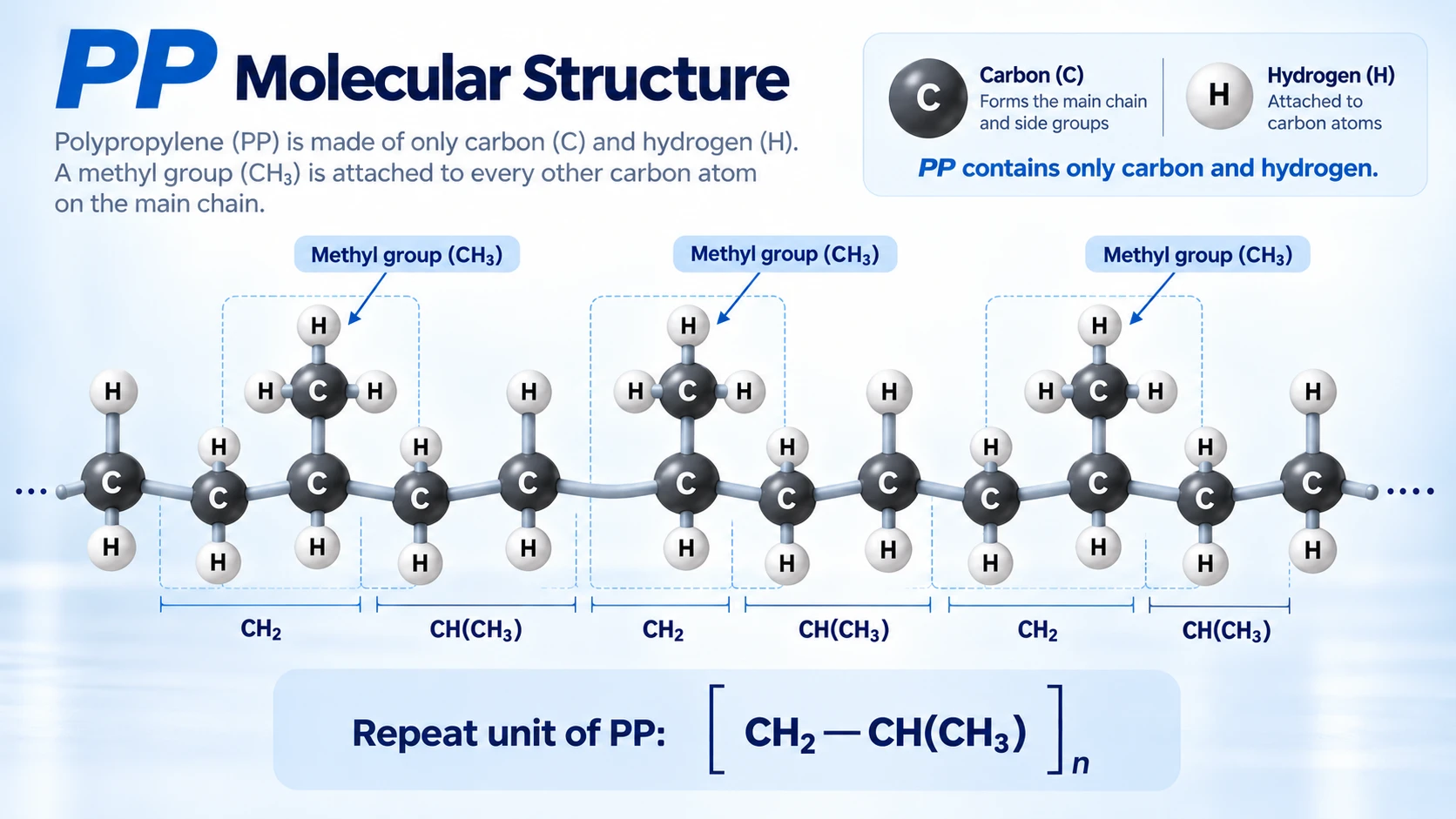
Polypropylene’s molecular formula is (CâHâ)â, and its repeating unit is [CHâ, CH(CHâ)]. The backbone is a long chain of carbon atoms, each bonded to hydrogen atoms, with a methyl (CHâ) side chain attached to every other carbon.
This side chain is not just decoration. It keeps the molecules from packing too neatly, making the material tougher and more resistant to bending.
Why only carbon and hydrogen
PP is polymerized from propylene monomer. Propylene’s formula is CâHâ, containing only carbon and hydrogen. Linking them one by one yields polypropylene, which naturally contains only carbon and hydrogen.
Precisely because the backbone has only carbon and hydrogen, PP contains no chlorine, no bisphenol-A structure, and none of the plasticizers in the usual sense. These are exactly the points often discussed about PVC and PC.
The long-chain form is also key
Having only carbon and hydrogen is one layer; being a very long chain is another.
PP is not a small molecule but a very long chain, with a molecular weight reaching hundreds of thousands. The larger the molecule, the less it volatilizes and the less it seeps into skinâthis is the basis for its use in skin-contact products.
So PP's structure has two layers: only carbon and hydrogen as elements, and a stable long chain as form. Together, they form its chemical baseline of 'little reaction, no leaching.'
What this structure means for 3D printing
Carbon and hydrogen alone make PP resistant to most acids, alkalis, and common solvents, and unlikely to react with contacting objects. The long-chain form makes it bend-resistant and hard to break. These two are exactly the rare capabilities needed for 3D-printed functional parts, and the underlying reason PP can make living hinges and chemical-resistant parts.
POLIVE PPpro⢠modified PP 3D printing filament is modified on this structural foundation: it retains the lightness, chemical resistance, and repeated-flexibility that PP’s carbon-hydrogen backbone brings, optimizes print adhesion and interlayer bonding, and follows a no-heated-bed, no-enclosure, open-cover printing route.
Conclusion
PP's molecular formula is (CâHâ)â; its backbone consists only of carbon and hydrogen, and its form is a long chain with a methyl side chain on every other carbon. Simple elements make it unreactive and non-leaching; a long enough chain makes it non-volatile and hard to seep. Together, this is the underlying reason for PP's 'chemically stable' nature.
Common Questions
How is PPpro modified PP 3D printing filament related to general-purpose PP?
PPpro is a PP filament modified for FDM 3D printing. It retains PP’s light weight, chemical resistance, and repeated-flexibility nature, and optimizes print adhesion and interlayer bonding.
Is PPpro modified PP 3D printing filament difficult to print?
PP’s difficulty lies in adhesion and warping, not temperature. PPpro follows a no-heated-bed, no-enclosure, open-cover routeâeven faster in an air-conditioned roomâand prints stably with proper bed preparation.
PP 为什么只由碳和氢构成?
丙烯单体只含碳氢,聚合后重复单元仍是长碳链加侧甲基,没有氯、氧、氮这些杂原子,所以分子组成很干净。
这种结构带来什么特性?
化学惰性强、耐酸碱、不吸水、不需要增塑剂就有柔韧性,也不含双酚 A;同时表面能低,胶和漆不容易附着。
对 3D 打印有什么影响?
好处是件耐化学、稳定、轻;难点是低表面能导致首层难粘、半结晶导致收缩。PPpro™ 用 PPLOCK26811 和开放散热分别对应这两点。