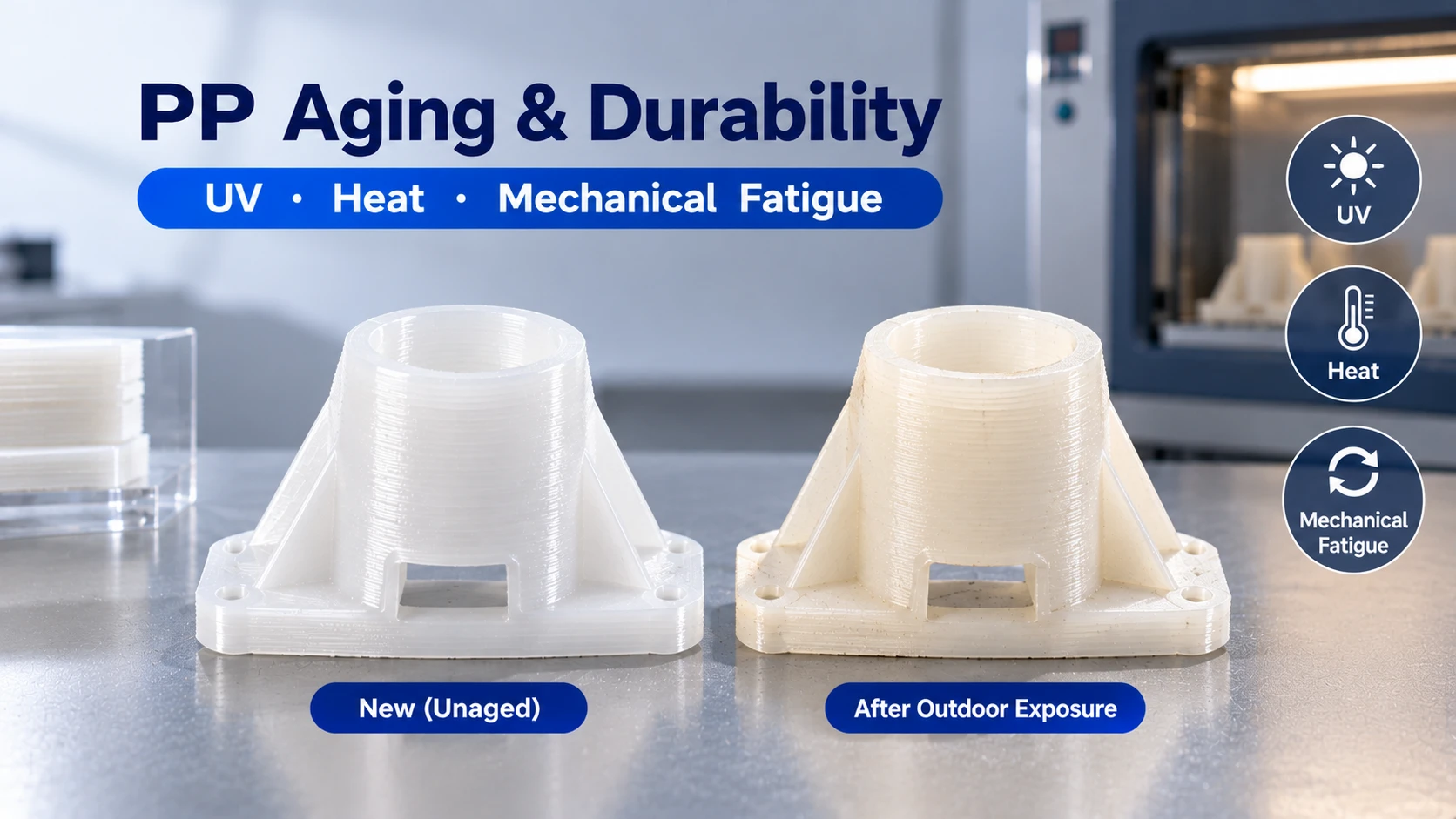
How Long Do PP Prints Last? Ageing and Service Life of PP
PP printed parts do not have a fixed service life that applies to all scenarios.
Actual service life depends on material formulation, temperature, light exposure, mechanical load, usage time and the specific environment. A part used indoors away from light and a part exposed long-term to sunlight, high temperature and outdoor environments may show significantly different aging rates.
For functional PP printed parts, evaluating service life usually requires focusing on three categories of factors:
- Thermal-oxidative aging
- UV aging
- Mechanical fatigue
Therefore, rather than simply asking “how many years can PP last,” it is better to first clarify the actual use environment of the part, and then test against the corresponding aging mechanism.
Where does PP aging begin?
PP is a polyolefin material. Under the combined effects of heat, oxygen and light, the polymer structure may gradually change, leading to a decline in material properties over time.
The aging process usually does not occur suddenly, but may go through gradual changes.
Early manifestations may include:
- Surface gloss change
- Color changes
- Surface condition change
As aging progresses further, the mechanical properties of the material may change, for example:
- Toughness decrease
- Impact performance decrease
- Elongation at break reduction
- The material becomes more prone to cracking
In more severe cases, cracks or other obvious damage may appear on the surface.
Ultraviolet light, high temperature and oxygencan all accelerate the polymer aging process, so long-term outdoor exposure is usually more severe than an indoor, light-shielded environment.
For a specific PP material, the actual aging rate also depends on the material formulation and use environment, so the specific service life cannot be inferred solely from the material name “PP.”
Why does ultraviolet light affect PP?
Outdoor PP printed parts need special attention to ultraviolet light.
After long-term UV exposure, the material may undergo photo-oxidation, and over time may show:
Color change â Surface property change â Toughness decrease â Cracks or other failure
However, different PP formulations do not have the same tolerance to ultraviolet light.
If the product needs long-term outdoor use, the following should be considered:
- Whether the material contains a UV stabilization system
- Actual solar radiation intensity
- Exposure time
- Ambient temperature
- Humidity and other environmental factors
- The color and structure of the part
Therefore,You cannot directly assume that all PP printed parts are suitable for long-term outdoor use just because PP itself has good chemical stability.
Mechanical fatigue: parts can also “wear out” from use
Many PP printed parts do not fail from long-term storage, but because ofrepeated stress.
For example:
- Living hinge
- Snaps
- Clips
- elastic structures
- repeatedly bent connectors
Each time these parts receive a load, it may not exceed the instantaneous strength of the material, but after a large number of cycles, fatigue damage may still occur.
Fatigue failure is usually related to the following factors:
- Stress magnitude
- number of cycles
- Bending angle
- part geometry
- stress concentration
- Print orientation
- Interlayer bonding
- Use temperature
PP has good flexibility and resistance to repeated deformation, so it is often used in structures that require repeated bending, such as living hinges.
But how many cycles it can specifically withstand cannot be judged solely from the material name; it needs to be verified against the actual part design and test conditions.
Why can the same PP part have very different lifetimes in different environments?
The service life of a part is not determined by time itself, but by what it experiences during that time.
For example:
Indoor, shielded from light, low load
Relatively few aging factors, mainly focusing on long-term mechanical load and temperature.
Outdoor, direct sunlight
In addition to temperature and mechanical load, it also faces long-term UV exposure.
High-temperature environment
Rising temperature may accelerate material aging, and may also increase the risk of creep and decline in mechanical properties.
High temperature + load + UV
This is a more severe combined environment, and service life cannot be simply inferred from room-temperature material data.
Therefore, the actual service life of the same PP material in different application environments may differ greatly.
How to estimate the service life of PP printed parts?
One of the more reliable methods is to performaccelerated aging testing.
By raising the test temperature, increasing UV exposure intensity or increasing the load, changes in the material or part can be observed within a short period.
Common testing approaches include:
Thermal aging test
Place samples at a specified temperature for a long time, then periodically test:
- Appearance
- Color
- Tensile performance
- impact performance
- Elongation at break
UV aging test
Expose to ultraviolet light under controlled conditions, and observe:
- Color changes
- Surface changes
- Mechanical property changes
- Cracks
Fatigue test
Have the part undergo repeated cycles according to its actual working mode, for example repeatedly bending clips or living hinges, and record the number of cycles before failure.
Can accelerated aging testing directly predict several years of life?
The time in accelerated testing cannot be simply converted into actual service years.
For example, the UV exposure intensity, temperature and humidity in a laboratory are not exactly the same as in a real outdoor environment.
Therefore, accelerated aging testing is more suitable for:
Comparing durability differences between materials, observing performance change trends, and screening more suitable materials and formulations.
If specific life prediction is needed, actual environmental data and a verified life model are also required.
Therefore, for questions like “how many years can it be used outdoors,” it is not recommended to directly give an absolute number of years based only on short-term accelerated testing.
Actual environmental testing is also important
In addition to laboratory accelerated testing, long-term exposure testing in the actual environment is also valuable.
A simple method is to performoutdoor exposure testing:
- Prepare multiple identical test samples;
- Place them in the actual use environment;
- Periodically photograph and record appearance changes;
- Measure color or surface condition changes;
- Periodically sample for mechanical property testing;
- Record temperature, sunlight and exposure time.
The data obtained this way can help determine the change pattern of the material in the real environment.
For products requiring long-term outdoor use, combining laboratory accelerated testing with actual environmental testing is usually more informative than relying on a single test.
How to extend the service life of PP printed parts?
1. Reduce long-term UV exposure
If the part does not need to receive direct sunlight, you can try to choose:
- A shielded location
- Indoor environment
- Light-shielded installation method
For long-term outdoor applications, materials that have undergone appropriate weather-resistant design and verification should be selected.
2. Control long-term use temperature
High temperature may not only affect the immediate mechanical properties of the part, but may also accelerate long-term aging and creep.
Therefore, the part should be avoided from working long-term in an environment close to its actual thermal performance limit.
3. Reduce long-term mechanical stress
For clips, hooks and elastic structures, long-term stress can be reduced through structural design.
For example:
- Avoid excessive preload
- Avoid long-term overload
- Reduce sharp stress concentrations
- Optimize bending radius
- Reasonably increase local structural strength
For long-term load-bearing parts, “reducing working stress” is often more effective than simply adding material.
4. Pay attention to the chemical environment
Certain chemical media, cleaning agents or other environmental factors may affect the long-term performance of the polymer.
Therefore, if the printed part needs long-term contact with specific chemicals, it is best to verify against the actual medium, concentration, temperature and contact time, rather than judging only by PPâs general chemical resistance.
How long can PP printed parts actually last?
This question has no single answer that applies to all PP printed parts.
An indoor, low-load part may remain in good condition for a long time; while a part that is exposed to long-term outdoor sun, continuous high temperature and repeated loading will require specialized durability testing to assess its life.
A more reasonable way to judge is:
Use environment â Aging mechanism â Accelerated testing â Actual environment verification â Life assessment
For actual product development, this is more reliable than directly giving a number like “PP can be used for X years.”
Summary
- PP printed parts do not have a fixed, universal service life.
- The long-term durability of PP requires focusing onthermal-oxidative aging, UV aging and mechanical fatigue.
- Outdoor use, high temperature and long-term mechanical load all increase durability requirements.
- PP has good flexibility and resistance to repeated deformation, but the specific fatigue life still depends on the material, structure and printing conditions.
- Accelerated aging testing is suitable for comparing materials and observing performance changes, but it cannot be simply converted into actual service years.
- Actual environmental exposure testing can help verify the long-term performance of the material under real conditions.
- Reducing UV exposure, controlling temperature, lowering long-term stress and verifying against the specific chemical environment can help extend the service life of PP printed parts.
- For long-term outdoor or high-load applications, durability testing should be performed according to the actual environment and product requirements, rather than inferring life solely from the material name “PP.”
How Long Do PP Printed Parts Last?
There is no fixed service life that applies to every situation. Indoors, away from light and under low load, a part can last a long time; in direct outdoor sun, at high temperature, or when heat, load and UV combine, degradation is much faster.
How Does UV Affect PP?
UV is the main external cause of PP ageing: prolonged exposure makes it brittle, discoloured and chalky on the surface. For outdoor use, plan for shielding or surface protection rather than relying only on the material's chemical resistance.
Can a Part Also Fatigue Over Time?
Yes. Repeated bending, snap-fit cycles and continuous vibration are mechanical fatigue — a failure path independent of chemical ageing. Living-hinge parts should be validated against the actual number of opening cycles.
Can Accelerated Ageing Tests Predict Years of Service Life?
Not by direct conversion. Thermal and UV accelerated ageing are useful for comparing and screening options; real service life still has to be confirmed with outdoor exposure coupons in the actual environment.
Related Reading
- Can PP printed items be placed outdoors?
- What is the difference between PP and ASA? Which one should be used for outdoor applications?
- Can 3D Printing Make Sports and Outdoor Gear Accessories? PP’s Fatigue Resistance in Action
- Are PP 3D-printed parts drop-resistant? A comparison of impact resistance: PP vs. PETG and ABS
- Are PP Prints Strong? How to Assess PP’s Mechanical Properties
- How Much Temperature Can PP Prints Withstand? PP’s Heat-Resistance Performance