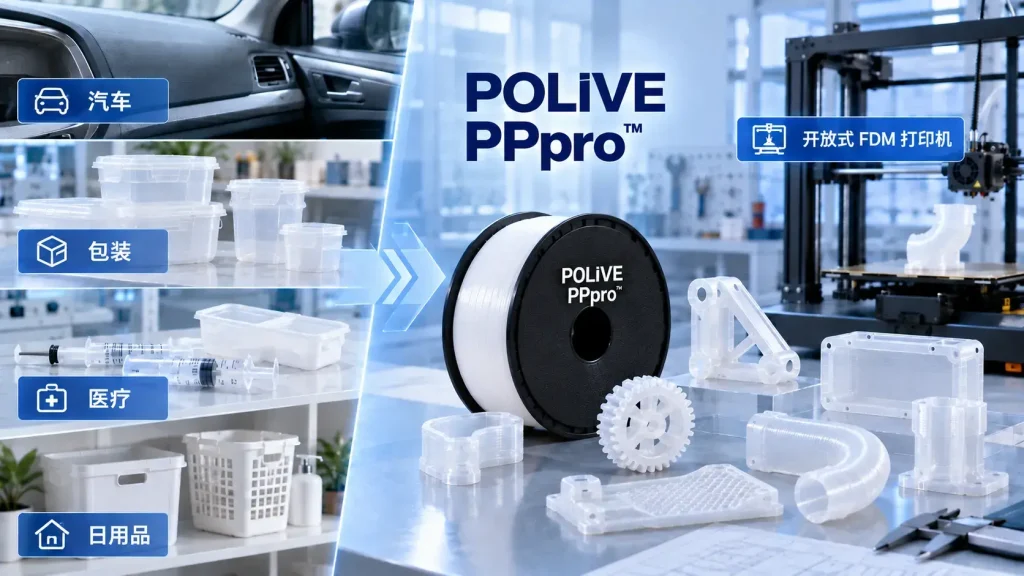
Where is PP used in industry? Understand the traditional applications, and you will see why it is worth using for 3D printing
PP (polypropylene) is one of the most widely used general-purpose plastics in the world. It shows up in everything from automotive parts and food packaging to medical supplies and everyday consumer goods.
Its ability to enter so many industrial sectors comes down to itslow density, chemical resistance, toughness, fatigue resistance, and good heat resistance.
So where exactly is PP used in traditional industry?
Automotive
PP is used in large quantities for automotive interior, exterior, and functional parts, for example:
- Bumpers and related parts
- Some components in dashboards and door panels
- Parts related to air-conditioning systems
- Interior structural parts
For automotive manufacturing, PP’s low density helps achieve lightweighting, while its toughness and chemical resistance suit plastic parts that see long-term use.
Packaging
Packaging is one of PP’s most common application areas.
PP appears in food containers, cups, bottle caps, film, and other packaging products.
PP has low water absorption, and different formulations and processing methods can deliver different stiffness, clarity, and heat resistance, so it can meet a wide range of packaging needs.
It should be noted thatPP being suitable for food contact does not mean that every PP product can be used directly for food contact. Practical use also requires consideration of the specific formulation, additives, processing, and the relevant regulations and testing requirements.
Medical
PP is also widely used in medical and laboratory supplies, for example:
- Syringes and related components
- Medical packaging
- Laboratory containers
- Medical device trays
Some PP products can be sterilized at high temperature depending on their formulation and design, which is why they are used in medical settings that demand heat and chemical resistance.
Here too a distinction is needed:material properties versus specific product certification. Whether a medical use is appropriate must be judged from the product’s specific specifications, sterilization method, and the relevant regulatory requirements.
Everyday consumer goods
In daily life, PP is even more common.
Storage boxes, clothes hangers, basins and buckets, food containers, household items, and some toys may all be made of PP.
One important reason is that PP has good toughness and fatigue resistance. For products that must be bent repeatedly, knocked about, or used for a long time, these properties have real value.
Why do these applications relate to 3D printing?
PP in traditional industry is usually processed bymature processes such as injection molding, extrusion, and blow molding.
These processes are ideal for high-volume production, but when a product calls for:
- Small-batch customization
- Rapid design changes
- Individualized structures
- Functional prototypes
- Functional prototypes
then FDM 3D printing offers another way to manufacture it.
This is one of the reasons PP has entered the field of 3D printing.
For example, the structures of some conventional PP products can be carried over into 3D printing applications:
- Custom jigs and fixtures
- Functional prototypes
- Small-batch container prototypes
- Structural and protective parts
- Functional parts that flex repeatedly
Of course,3D printing is not a simple replacement for conventional injection molding. For high-volume products with tight dimensional-consistency requirements, injection molding still has a clear advantage; 3D printing is better suited to rapid iteration, customization, and small-batch manufacturing.
From traditional PP to FDM 3D printing
PP has already proven its material value in traditional industry.
The real question is:how do you make this mature industrial material easier to bring to desktop FDM 3D printing?
That is exactly the direction POLIVE PPpro™ focuses on.
PPpro™ is a modified PP filament developed for FDM 3D printing. Its goal is to lower the barriers that traditional PP poses during printing — warping, adhesion, and interlayer bonding — so that more users can try PP on common FDM machines.
From injection molding to 3D printing, what changes is not only the manufacturing method but also the way the material is used.
PP already exists in a vast number of industrial products; what PPpro™ tries to do is build a bridge between traditional PP material and FDM 3D printing.相关阅读:为什么 PP 常被用于食品接触?
PP 在工业上主要用在哪?
汽车部件、包装、医疗用品、日常消费品这几大块都能看到它,是世界上用量最大的通用塑料之一:轻、耐化学、抗疲劳、成本可控。
工业上用得好,为什么 3D 打印里少见?
注塑是高压快速成型,FDM 是逐层堆积,PP 的半结晶收缩和低表面能在 FDM 上会变成翘边、粘不住、层间弱。难点在工艺适配,不在材料性能。
现在用 3D 打印做 PP 件,门槛降在哪?
改性线材把打印难题先解掉:不加热床、不封箱,开放机器在空调房里就能打;首层用裙边加 PPLOCK26811,零件端做圆角和均匀壁厚。于是打样、小批量、备件这类场景可以直接用 PP 做原型。
Related Reading
- What Is Polypropylene (PP)? PP for 3D Printing from a Materials Perspective
- Can 3D printing be used to produce automotive parts? Applications of PP (polypropylene) in the automotive sector
- Can 3D Printing Make Packaging Prototypes? Clamshell Boxes, Snap Fits and One-Piece Molding
- Can 3D Printing Make Lab Equipment? Chemical Resistance of PP
- How should you choose between 3D printing for prototyping, mold making, and small-batch production?
- What Is PP? Understanding Polypropylene at a Glance