What Nozzle Should Be Used for PP Printing? Nozzle Wear and Material Selection
A brass nozzle works for unfilled PPpro; pick a wear-resistant one for abrasive compounds, and keep extrusion steady and clean.
What Nozzle Should Be Used for PP Printing?
PP itself is usually not highly abrasive, so forPP filament without obviously abrasive fillers, ordinary brass nozzles usually meet everyday printing needs.
What really needs attention iswhether the filament formulation contains reinforcing materials such as mineral fillers, glass fiber, or carbon fiber. The abrasiveness of these components is usually significantly higher than that of pure polymer, and long-term printing may accelerate changes in the nozzle bore diameter.
Therefore, when choosing a nozzle, rather than only looking at “whether the base material is PP,” it is better to first look at:
What has been added to this spool of PP filament?
What are PP’s requirements for the nozzle?
During printing, the nozzle mainly needs to balance three aspects:
thermal conductivity, wear resistance, and inner-bore surface condition.
Thermal conductivity
The nozzle needs to efficiently transfer heat from the hot end to the material, keeping the melt at a stable processing temperature.
Different nozzle materials have different thermal conductivities, which may also affect heat transfer and temperature response.
Wear resistance
The inner bore of the nozzle must withstand the friction generated as molten material passes through over the long term.
For pure polymer filament, this wear is usually limited; but if the filament contains abrasive fillers, nozzle wear may accelerate significantly.
Inner-bore surface condition
The smoother and more stable the inner bore of the nozzle, the better it is for maintaining consistent extrusion.
Therefore, nozzle selection should not be based only on the material name; the actual processing quality and long-term performance must also be considered.
Under What Conditions Does a PP Nozzle Wear More Easily?
Mineral-filled PP
If the PP formulation containsmineral fillers such as talcum powder and calcium carbonate, long-term printing may accelerate nozzle wear.
For this type of filament, if printing for a long time, you can consider using a wear-resistant nozzle.
Glass-fiber or carbon-fiber reinforced PP
Glass fiber and carbon fiber have strong abrasiveness.
If PP filament containing glass or carbon fiber is used long-term, the wear rate of ordinary brass nozzles may be significantly higher than that of pure polymer filament, so it is usually more suitable to choose hardened steel or other wear-resistant nozzles.
Low-warp modified PP, such as PPproâ¢
If a modified PP’s formulation primarily improves printing performance through processing aids, nucleation modification, etc., and does not contain obvious abrasive reinforcing fillers, then the wear pressure on the nozzle is usually relatively low.
For POLIVE PPpro™, the specific long-term wear performance should still be based on actual print tests.
How to Choose PP Nozzle Material?
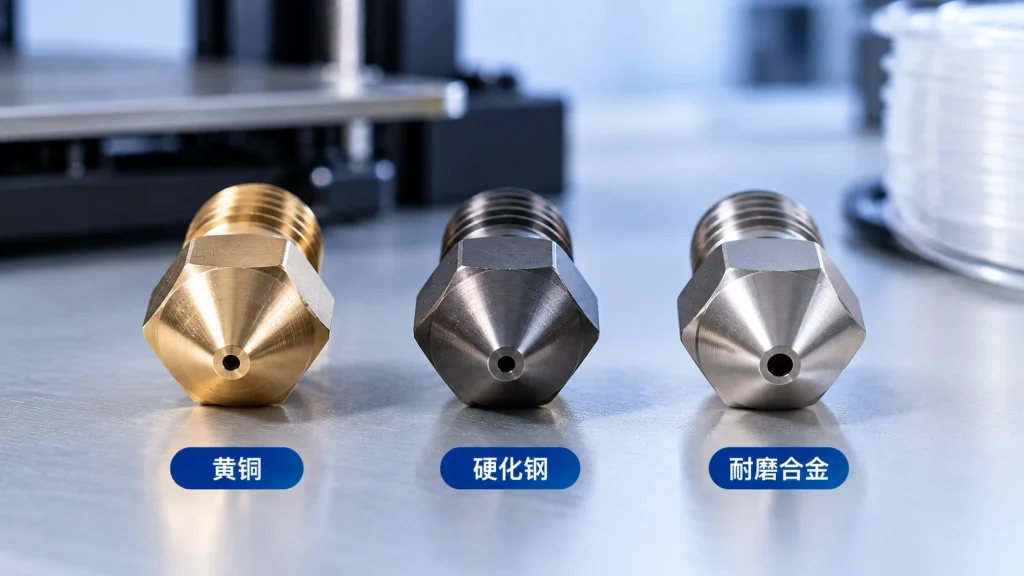
Brass nozzle
Advantages:
- Good thermal conductivity;
- Low price;
- Faster heating response;
- Usually sufficient for ordinary pure polymer filament.
Disadvantages:
- Softer material;
- Limited wear resistance;
- When printing abrasive fillers for a long time, the bore diameter may gradually change.
For ordinary PP filament, brass can usually be the default choice.
Stainless steel nozzle
Stainless steel nozzles usually have better wear resistance than ordinary brass, and are also suitable for some applications with higher material-contact requirements.
Its thermal conductivity is usually not as good as brass, so when using it, you need to pay attention to the actual temperature performance and make appropriate adjustments based on the equipment.
If you only print ordinary PP without obvious wear-resistance needs, you do not necessarily need to upgrade specifically to a stainless steel nozzle just for PP itself.
Hardened steel nozzle
Hardened steel has strong wear resistance and is more suitable for filaments containing abrasive components such as mineral fillers, glass fiber, or carbon fiber.
Its main advantage is long-term wear resistance.
Compared with brass, its thermal conductivity is usually lower, so at higher flow rates or higher print speeds, you need to pay attention to whether the actual nozzle temperature can meet the material’s processing requirements.
The price is also usually higher than that of ordinary brass nozzles.
Wear-resistant alloy or ruby nozzle
This type of nozzle is mainly aimed at long-term, batch printing scenarios with high wear-resistance requirements.
They usually have higher wear resistance, but are also more expensive.
If you only print ordinary PP, it is usually unnecessary to directly choose this type of nozzle just for wear resistance.
How to Tell Whether a Nozzle Is Already Worn?
Nozzle wear usually does not happen suddenly, but is a gradual process.
You can focus on observing the following signals.
1. Extrusion volume gradually changes
If the nozzle bore changes due to wear, the actual extrusion volume may deviate from the original calibrated value.
This may manifest as:
- Lines become thicker than before;
- Details become unclear;
- Dimensions change;
- The original flow or extrusion-multiplier settings become increasingly difficult to restore to normal printing.
However, these phenomena may also be caused by other factors such as flow calibration, extruder, temperature, or filament condition, so nozzle wear cannot be judged based on a single phenomenon alone.
2. Abnormal print surface
If the nozzle condition changes, the print surface may show phenomena such as irregular texture, uneven extrusion, or increased stringing.
It is also necessary to combine other parameters for troubleshooting, rather than directly attributing it to a nozzle problem.
3. Inspect the nozzle after removal
If you suspect nozzle wear, you can remove the nozzle for inspection.
Key observations:
- Whether the nozzle orifice is still round;
- Whether the bore diameter shows obvious enlargement;
- Whether the inner bore shows obvious wear marks or grooves.
If you confirm that the nozzle has undergone obvious changes, you should consider replacing it.
How Often Does the Nozzle Need to Be Replaced?
There is no fixed replacement interval for nozzles that applies to all filaments.
A more reasonable approach is based on:
printing hours + filament type + actual print performance
for management.
For ordinary pure polymer filament, brass nozzles usually last a long time; while filaments containing abrasive components such as mineral fillers, glass fiber, or carbon fiber require more frequent inspection of the nozzle condition.
Therefore, rather than stipulating “replace after a certain number of printing hours,” it is better to establish your own inspection cycle and decide whether to replace based on the nozzle’s actual wear.
When replacing the nozzle, also note:
- The hot end needs to be heated according to the device instructions;
- Use appropriate tools;
- Be careful of high-temperature burns;
- Avoid twisting the heating cartridge and thermistor cables;
- After installation, re-check the nozzle condition and recalibrate as needed.
How to Choose the PP Print Nozzle Bore Diameter?
In addition to the nozzle material,bore diameteralso affects the print result and efficiency.
0.4 mm: General-purpose choice
0.4 mm is a very common general-purpose bore diameter, achieving a good balance between detail and extrusion flow.
If you are just starting to print PP, you can prioritize starting from 0.4 mm.
0.6 mm: Large parts and efficiency priority
If you are printing large-sized parts, or pay more attention to print efficiency, you can consider 0.6 mm.
A larger nozzle bore can increase the single-pass extrusion volume and reduce printing time under appropriate layer-height and line-width settings.
However, the final print speed is still limited by the hot-end heating capacity, extruder capability, and material flow characteristics; switching to 0.6 mm does not necessarily allow unlimited speed increases.
0.3 mm: Fine structures
If you pay more attention to small-size details, you can consider 0.3 mm.
But smaller bores are more sensitive to material flow, temperature stability, and print parameters, and also require better nozzle and extrusion system condition.
What Needs to Be Re-adjusted After Replacing the Nozzle?
If you switch from 0.4 mm to another bore diameter, it is recommended to re-check the relevant print parameters.
Pay special attention to:
- Flow;
- Extrusion multiplier;
- Line width;
- Layer height;
- First-layer extrusion;
- Print speed;
- Nozzle temperature.
Even if you still use the same material, it is not recommended to directly copy all the original parameters after replacing the nozzle.
First do a small-size test, then adjust gradually; this makes it easier to find a stable combination.
Summary
PP itself is usually not highly abrasive, so for ordinary PP filament,brass nozzles usually already meet most everyday printing needs.
. But if the filament contains abrasive components such as mineral fillers, glass fiber, or carbon fiber, you should pay more attention to the nozzle’s wear resistance.
A few key points:
- Ordinary PP: brass nozzles can usually be the default choice.
- Containing mineral fillers, glass fiber, or carbon fiber: consider hardened steel or other wear-resistant nozzles.
- To judge nozzle wear, you can observewhether the extrusion state, print surface, and nozzle orifice have changed.
- The nozzle replacement interval should be combined withprinting time, filament type, and actual wear conditionto judge, rather than setting a uniform number of hours.
- 0.4 mm is a relatively general-purpose choice.
- 0.6 mm can be used for large parts or efficiency-priority printing.
- 0.3 mm is more suitable for parts with high detail requirements.
- After replacing the nozzle bore diameter, you should re-check parameters such as flow, line width, layer height, and temperature.
For POLIVE PPpro™, if you use a formulation without obvious abrasive reinforcing fillers, ordinary brass nozzles can serve as a conventional starting point. For long-term use, it is still recommended to inspect based on actual printing hours and nozzle condition, rather than judging nozzle life solely by the material name.
打 PP 该配什么材质的喷嘴?
PP 本身通常不具强磨蚀性,不含明显磨蚀填料的线材用普通黄铜喷嘴就能满足日常打印,重点看导热、耐磨和内孔表面状态。
什么时候喷嘴磨损会明显加快?
换成矿物填充、玻纤或碳纤增强的 PP 时,磨料会加速磨损内孔;低翘改性 PP 如 PPpro™ 不含这类增强填料,对喷嘴更友好。
怎么判断喷嘴该换了?
出丝变细或偏斜、层宽不稳、表面突然粗糙、同样参数下需要更高温度才出得顺,都是内孔磨损或积料的信号。换喷嘴后记得重新校准首层和流量。
喷嘴孔径怎么选?
常规件用标准孔径即可,追求效率可考虑大孔径,但要注意热端流量上限和层间结合;小件别一味提速,PP 的冷却和层间结合比出丝量更需要留余量。
Related Reading
- What to Do When PP Printing Jams? Troubleshooting Steps for Poor Extrusion
- What Print Speed Should Be Set for PP? The Impact of Speed on Print Quality
- How to Store PP Filament? Drying, Sealing, and Everyday-Use Tips
- How to Judge the Quality of Modified PP Filament? Which Tests to Check When Buying
- What Is PPpro? A Modified PP 3D Printing Filament That Needs No Heated Bed and Makes Living Hinges
- How Good Is the Surface Quality of PP Prints?