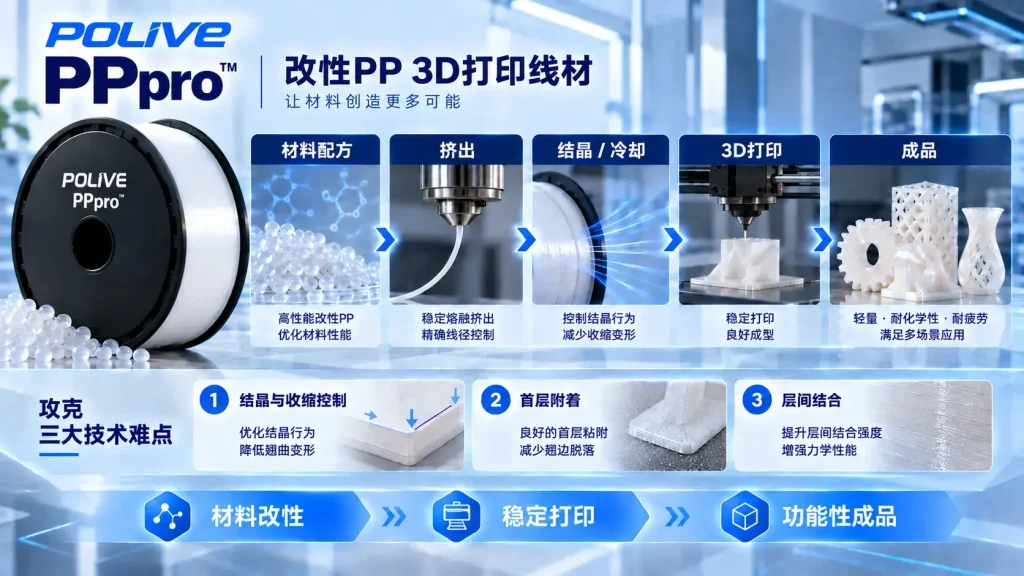
How Is POLIVE PPpro™ Made? Three Key Technical Challenges of Modified PP Filament
How Is POLIVE PPpro™ Made?
Turning PP into 3D printing filament looks straightforward on the surface:
Compounding → Mixing → Extrusion → Cooling → Sizing → Spooling
But to actually turn PP into astable filament suitable for FDM 3D printing, the challenge is not simply extruding the material into a strand.
PP inherently has semi-crystalline characteristics, low surface energy and good flexibility. On one hand these material properties give PP many practical performance advantages; on the other, they also create challenges for FDM printing.
For POLIVE PPpro™, one of the cores of material modification is adjusting around these printing difficulties.
Challenge 1: Crystallization and Shrinkage Control
PP is asemi-crystalline polymer.
During printing, molten PP gradually cools and crystallizes after being extruded from the nozzle. At the same time, the material undergoes volumetric shrinkage.
If cooling and shrinkage are uneven across different regions, internal stress can develop, which further shows up as:
- Edge curling
- Warping
- Size changes
- Model deformation
Therefore, PP 3D printing is not merely about “turning the temperature up or down.”
Both crystallization behavior and the cooling process affect the final print result.
POLIVE PPpro™ adjusts PP’s crystallization behavior through material formulation design, aiming to give the material a more stable forming process during FDM printing and thereby reduce the tendency to warp caused by uneven shrinkage.
This is not about making PP “not shrink,” but ratherusing material design to improve the influence of shrinkage and crystallization on printing stability.
Challenge 2: First-Layer Adhesion
This is a very typical problem in conventional PP 3D printing.
PP’ssurface energy is low, so the molten material has limited ability to adhere to many common print surfaces.
Simply put:
The material itself does not easily “stick” to the build plate.
If first-layer adhesion is insufficient, the following may occur:
- The first layer lifts
- The model shifts
- Corners detach
- Subsequent printing fails
This is why conventional PP printing usually requires special attention to the build plate and surface treatment.
How does PPpro™ improve first-layer adhesion?
PPpro™’s material design focuses not only on PP’s own mechanical and thermal properties, but also on the interfacial behavior between the material and the build plate.
Through targeted modification design, PPpro™ aims to improve first-layer adhesion performance and reduce the build plate’s dependence on special treatments.
For example, with a suitable PEI print surface and parameters, PPpro™ printing tests can be carried out directly.
For POLIVE PPpro™, testing can start with the heated bed turned off and printing at room temperature. Actual adhesion is still affected by factors such as PEI surface type, printer condition, first-layer height, print speed and model size. It is recommended to first make sure the build plate is clean and then gradually adjust the relevant settings based on first-layer performance.
Therefore, a more accurate way to put it is:
PPpro™ aims to improve the first-layer adhesion problems of conventional PP and reduce the build plate’s dependence on special treatments.
Challenge 3: Interlayer Bonding
FDM 3D printing is a layer-by-layer forming process.
After each layer is extruded from the nozzle, it needs to make contact, fuse and undergo molecular diffusion with the material already formed below.
If interlayer fusion is insufficient, the following may occur:
- interlayer cracking
- Reduced tensile strength
- Parts fracture along the print layer direction
- Delamination under load
For PP, material cooling and crystallization affect the interlayer fusion window, so it is necessary tostrike a balance between flowability, temperature and cooling rate.
PPpro™’s material design adjusts melt flow and interlayer fusion behavior, aiming to improve the bonding between adjacent layers during printing.
Final interlayer strength is still closely related to print temperature, print speed, cooling, print orientation and part geometry.
Why must all three problems be solved together?
PP 3D printing is not something that can be handled by solving just one problem.
For example:
Solve warping, but the first layer won’t stick → stable printing is still impossible.
The first layer sticks, but interlayer bonding is insufficient → the part may still crack.
Interlayer bonding is good, but shrinkage control is poor → large models may still deform.
So, for a modified PP 3D printing filament, the following need to be considered together:
① Crystallization and shrinkage
Reduce the tendency to deform caused by uneven shrinkage during printing.
② First-layer adhesion
Improve the interfacial bonding between the material and the build plate.
③ Interlayer bonding
Improve fusion and bonding between adjacent print layers.
Together, these three aspects determine PP’s final printing experience.
PPpro™ does not turn PP into PLA
PP and PLA are two different materials.
PPpro™’s goal is not to turn PP into PLA, but rather:
to make PP easier to print stably via FDM while preserving as much as possible the valuable material properties that PP itself has.
Therefore, PPpro™ still has PP’s typical characteristics, such as:
- low density
- Low water absorption
- good chemical resistance
- flexibility
- good fatigue resistance
The difference is that POLIVE, through material modification, makes these characteristics easier to bring into FDM 3D printing applications.
From a spool of material to the final printed part
Developing a PP 3D printing filament is not simply:
PP → Extrusion → Spooling
What really needs to be considered is the whole process:
Material formulation → Melt flow → Extrusion stability → Diameter control → Cooling → Crystallization behavior → Printing process → First-layer adhesion → Interlayer bonding → Final part performance
A problem in any one of these stages can affect the final print result.
This is also why, even though they are all called “PP filament,” the printing experience can differ noticeably between products.
What is POLIVE PPpro™ trying to solve?
The material performance of conventional PP is not the problem.
The real question is:
The issue is how to make these material properties easier for FDM users to use.
POLIVE PPpro™’s material design is built around several core challenges in PP 3D printing:
Shrinkage and warping → First-layer adhesion → Interlayer bonding
By improving these printing stages, PP can go from being “a relatively difficult material to print” to an FDM filament that is easier to test and apply.
This is also the core starting point for POLIVE developing PPpro™:
to keep PP’s material performance from being limited by printing difficulty.
Conclusion
Turning PP into 3D printing filament: the real difficulty is not extruding a strand, but enabling that strand to reliably complete the following during FDM printing:
Melting → Extrusion → Adhesion → Interlayer fusion → Cooling → Forming
One of the most critical challenges among these is:
Crystallization and shrinkage, first-layer adhesion, and interlayer bonding.
POLIVE PPpro™ optimizes for these issues through material modification, aiming to improve its user experience in FDM 3D printing while preserving PP’s core material properties.
把 PP 做成线材难在哪?
三个坎必须一起过:结晶收缩控制、首层粘附、层间结合。只解决其中一个,另外两个仍会在打印时暴露,所以改性配方和打印工艺要配套设计。
PPpro™ 是怎么解决首层粘附的?
不是靠把平台加热去烫住,而是配套专用胶水:PPLOCK26811 薄涂后等几分钟干透,直接打印,一次涂抹能连续打多次,清洁用酒精擦即可,再加裙边辅助。
PPpro™ 会把 PP 变成 PLA 吗?
不会。改性是为了让 PP 在 FDM 上可用,不是抹掉它本身的特性——轻、耐化学、抗疲劳、能做活铰链都还在。改的是打印难度,不是材料身份。