PP or Tritan for Baby Bottles: How to Choose
Baby bottles commonly come in three materials: PP, Tritan, and glass. This article focuses on PP and Tritan.
Neither contains bisphenol A, and both withstand high-temperature sterilization, but they differ noticeably in price and feel. Which to choose depends on what you care about.
PP: cheap, light, drop-resistant — but it clouds over time
PP bottles are inexpensive, light, and hard to break. They can be steam-sterilized and boiled, and they tolerate temperatures above 100°C.
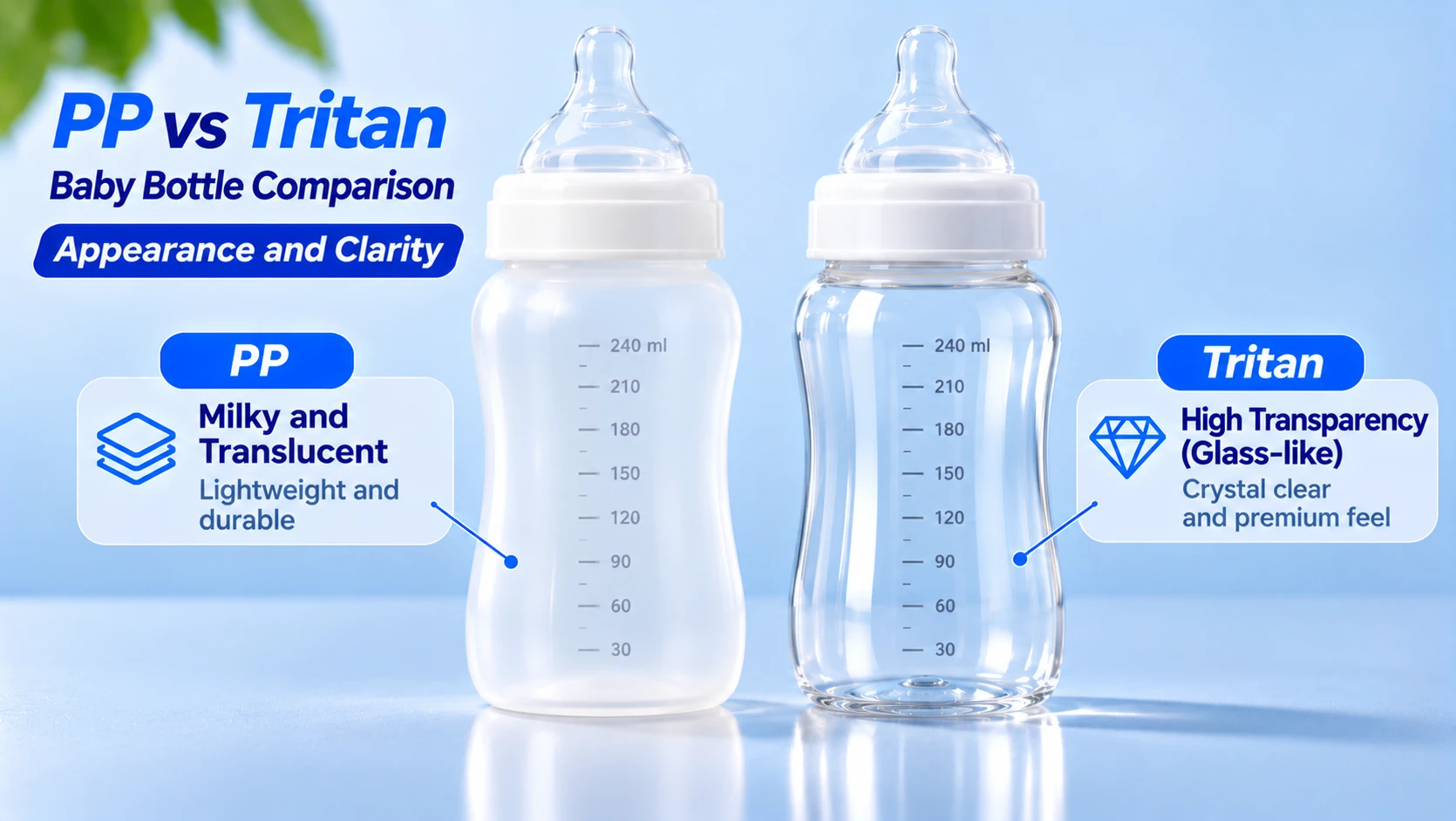
The bottle body is usually a translucent milky white. Over time it picks up scratches and starts to look cloudy.
PP’s heat ceiling is above 100°C, so routine steam and boiling sterilization are no problem. But after repeated sterilization the surface ages and clouds — that is a characteristic of the material, not a quality defect. Once the body is visibly cloudy and heavily scratched, it is time to replace it.
Tritan: clear as glass, drop-resistant, but expensive
Tritan is a copolyester. Its hallmarks are glass-like transparency, good impact resistance, and shatter resistance — and it is likewise free of bisphenol A.
Transparency is its biggest selling point. A Tritan body is so clear you can see how well the formula has dissolved, and it looks considerably better than PP.
Tritan also withstands high-temperature sterilization, typically rated to about 100°C. One caveat: Tritan’s molecular chain contains ester bonds, and long exposure to hot, humid conditions (the steam outlet of a sterilizer, for example) may accelerate aging, producing fine cracks, clouding, or embrittlement. So when using a Tritan bottle, follow the instructions for sterilization and do not leave it pressed against a hot steam vent for long.
The downside is a clearly higher price. Long-term high-temperature use can also produce fine cracks.
Glass: stable and clear, but heavy and fragile
Glass is more stable and more transparent, but it is heavy and breaks easily, so it is not suitable for a baby to hold alone.
If someone at home can watch the baby the whole time, glass is the least troublesome choice. But once the baby starts holding the bottle to drink, glass becomes impractical.
How to choose: budget and usage habits
Limited budget, want something simple and unbreakable: PP is enough. Light, drop-resistant, and cheap, so it survives being dropped by the baby. The trade-off is mediocre clarity and clouding over time, so it needs periodic replacement.
Care about clarity and appearance, willing to spend more: choose Tritan. The body is clear, you can see the contents, and impact resistance is good. Just sterilize as instructed and avoid leaving it against a hot steam vent for long.
Someone at home to watch the baby, want more stability: glass is the least troublesome. Stable, clear, and easy to clean — but heavy and fragile, so it is unsafe for the baby to hold alone.
Whichever you choose, keep these points in mind:
Sterilize as instructed — do not exceed the temperature or the time. Once the body shows scratches, clouding, or deformation, replace it; do not judge by how long you have used it. PP bottles age and cloud easily under repeated sterilization, so replacing every 3–4 months is recommended; Tritan surfaces scratch easily and yellow with long use, so 6 months is recommended. These are reference intervals — actual frequency of use and the condition of the bottle matter more.
What these differences mean for 3D printing
Both PP and Tritan can be made into 3D printing filament, but Tritan is rarely seen in FDM.
Tritan is a copolyester with a high printing temperature and demanding requirements on equipment and environment. FDM filament on the market is dominated by PLA, PETG, ABS, TPU, and PP; Tritan is not a mainstream option.
PP has traditionally been hard to print too — poor adhesion and severe warping. PPpro modified PP 3D printing filament solves exactly this problem: it keeps PP’s light weight, heat resistance, and chemical resistance while improving print adhesion and interlayer bonding, following a no-heated-bed, no-enclosure, lid-open approach.
If your part needs what PP is good at — light, heat-resistant, drop-resistant, chemically resistant — then PPpro is the right direction. If you want a highly transparent appearance, PP cannot achieve Tritan’s clarity, and you should consider another material.
Conclusion
The core differences between PP and Tritan are transparency and price: PP is translucent milky white, cheap, light, drop-resistant, and tolerates above 100°C, but clouds over time; Tritan is clear as glass, drop-resistant, and equally free of bisphenol A, but costs more, and long-term high-temperature sterilization calls for attention to aging.
Limited budget and want simplicity — PP is enough. Care about transparency and willing to spend more — choose Tritan. Someone at home to watch the baby and want stability — glass is the least troublesome. Whichever it is, replace the bottle once the body shows scratches, clouding, or deformation.
Common Questions
Which is safer, a PP or a Tritan bottle?
Neither contains bisphenol A, and both are common, safe bottle materials. PP is heat-stable; after repeated sterilization it clouds, but that is physical aging, not a safety issue. Tritan is equally safe, though long-term high-temperature sterilization may accelerate aging — just use it as instructed. The key question is not which is safer, but whether you use it the right way.
How often should a PP bottle be replaced?
The reference interval is 3–4 months. That is not a hard standard, though — it depends on how often you use it and on the condition of the bottle. If the body shows obvious scratches, clouding, or deformation, or retains an odor that will not wash out, replace it without waiting for the time to be up.
For 3D printing, PP or Tritan?
It depends on what the part needs. For light weight, heat resistance, drop resistance, and chemical resistance, choose PPpro. For a highly transparent appearance, Tritan is not a mainstream FDM option — look at PETG or other clear materials. PPpro follows a room-temperature bed, enclosure-free approach with a low barrier to entry, and suits functional parts.
What Are the Trade-Offs Between PP and Tritan Baby Bottles?
PP is cheap, light and drop-resistant, but clouds over time; Tritan is nearly as clear as glass and also drop-resistant, at a higher price. Glass stays clear and stable but is heavy and fragile.
How Do You Choose Based on Usage Habits?
Consider your budget, whether you need clarity to read the volume marks, how often you clean and sterilize, and the replacement cycle. If you sterilize at high temperature daily and care about appearance, spend more on Tritan; for a spare bottle or use on the go, PP is more practical.
Does Clouding Mean a PP Bottle Has Gone Bad?
Usually it is a visual change from fine surface scratches and repeated thermal cycles, not material failure. But visible cracks, deformation or a sticky feel mean it is time to replace it.
How Should You Read This Comparison in 3D Printing?
Printed parts are not suitable for something like a baby bottle that goes in the mouth, but the material logic carries over: choose another material for a transparent look, and use PP for functional parts that need toughness, chemical resistance and low weight.
Related Reading
·PP vs PS: What’s the Difference
·PP vs PET: Why Drink Bottles and Food Containers Use Different Plastics