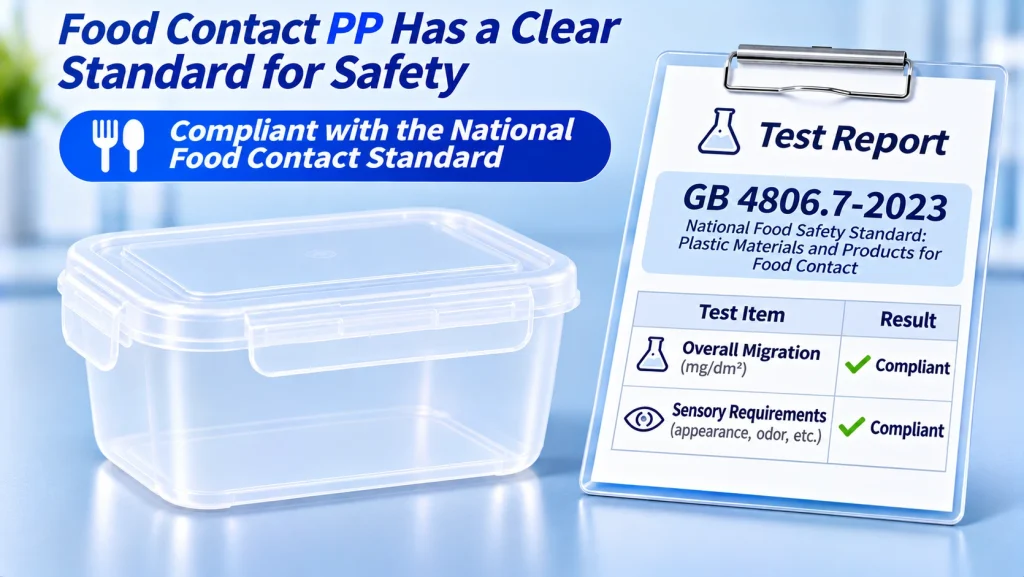
What Standards Must PP Food Contact Materials Meet?
Plastics that hold food are not held to the same standard as ordinary plastics.
In China they are governed mainly by the GB 4806 series of national food safety standards, with GB 4806.7 covering plastic materials and articles. The current version is GB 4806.7-2023, effective 2024-9-6, which merged the former separate standards for "plastic resins" and "plastic articles" into one.
What the Standard Regulates: It Is All About "How Much Can Migrate Out"
The core logic of the standard is not "what is in the material" but "how much of it ends up in the food after contact". That is exactly what migration testing is for.
Overall Migration: the total amount of non-volatile substances that migrate from the material into food. For general plastic articles the limit is ≤10 mg/dm², and for articles intended for infants and young children ≤60 mg/kg.
Specific Migration: limits for individual substances. For example, the migration limit for bisphenol A is 0.05 mg/kg, for phthalate plasticisers ≤0.3 mg/kg, and total primary aromatic amines must not be detectable (detection limit 0.01 mg/kg).
Sensory Requirements: no off-odours or discoloration. The soaking solution must not develop any abnormal smell, colour or other sensory deterioration.
Heavy Metals: ≤1 mg/kg, expressed as lead.
Potassium Permanganate Consumption: ≤10 mg/kg, reflecting the amount of migratable organic matter.
GB 4806.7-2023 introduced one important change over the previous version: a new requirement that total primary aromatic amines must not be detectable. Coloured plastics and multi-layer composites deserve particular scrutiny on this item.
How Migration Testing Works: Choose the Simulant by Food Type
Migration testing is carried out before a product leaves the factory. The type of food the article will contact determines which simulant is used.
Aqueous foods use 10% ethanol or water; acidic foods use 3% or 4% acetic acid; alcohol-containing foods use 20% ethanol; fatty foods use olive oil or a substitute. Temperature and contact time follow the intended conditions of use — for instance, long-term storage is 40°C for 10 days, while hot-filling or brief high-temperature use is 70°C for 2 hours or 100°C for 15 minutes.
A product is compliant only when both overall and specific migration come in within the limits. Put plainly, the logic is this: it is not about the material's formulation sheet, but about how much actually migrates into the food in real use.
Three Practical Tips for Consumers and Material Selection
First, check the label when buying PP products. Look for a "for food contact" marking and the number of the standard it complies with. GB 4806.7-2023 requires the label to state "for food contact" and the material, and products for infants and young children must be marked separately as "for infants and young children". If there is no such marking, do not use it for hot or oily food.
Second, do not use non-food-grade PP to hold food. Industrial PP containers and storage boxes may well be made of PP, but they were not produced to food contact standards and their migration has never been tested, so they should not be used to hold food.
Third, use it according to the instructions. If a temperature limit or microwave suitability is stated, do not exceed it. The standard is assessed under normal conditions of use; push past the temperature or time and even a compliant product can cause problems.
PPpro Does Not Currently Carry a "Food-Grade" Label
This article is purely an explanation of the standard.
Any food contact application of PPpro modified PP 3D printing filament is determined by the certifications it has obtained. Until a report is in hand, we make no claim and do not label it food-grade.
This is not a disclaimer but a compliance principle: PP as a material can be food-grade, but whether a finished part printed from PP filament may contact food depends on the specific formulation, the printing process and final testing. Material compliance does not equal finished-part compliance — a point covered in our earlier food contact article, so it will not be repeated here.
Conclusion
PP food contact materials must comply with GB 4806.7-2023. At its core is migration testing: overall migration ≤10 mg/dm², specific migration limited substance by substance, no sensory deterioration, and heavy metals ≤1 mg/kg as lead. The 2023 version added a new requirement for total primary aromatic amines.
For consumers, look for the "for food contact" marking and the standard number, do not use non-food-grade PP to hold food, and follow the instructions.
For PPpro, food contact applications depend on certification, and no food-grade claim is made before a report is obtained. A standard is a standard and a certification is a certification — the two should not be confused.
Common Questions
What Changed Between GB 4806.7-2023 and the Previous Version?
There are three main changes: the two separate standards for "plastic resins" and "plastic articles" were merged; total primary aromatic amines were added with a "not detectable" requirement (detection limit 0.01 mg/kg); and the list of permitted resins was revised from 102 to 187 entries. The compliance bar has been raised.
What Is the Difference Between Overall and Specific Migration?
Overall migration is "how much of everything has come out in total" and reflects the general level of migration. Specific migration is "how much of one particular substance has come out" and targets individual substances with clear health risks. Both must be tested and both must pass.
Can PPpro Printed Parts Touch Food Directly?
That depends on the certifications obtained. PP as a material can be food-grade, but whether a finished part printed from PPpro filament may contact food depends on the filament formulation, the printing process and final testing. Until a food contact certification report is in hand, no food-grade claim is made. Before any food contact application, first confirm the filament's certification status, then run migration testing under the actual conditions of use.