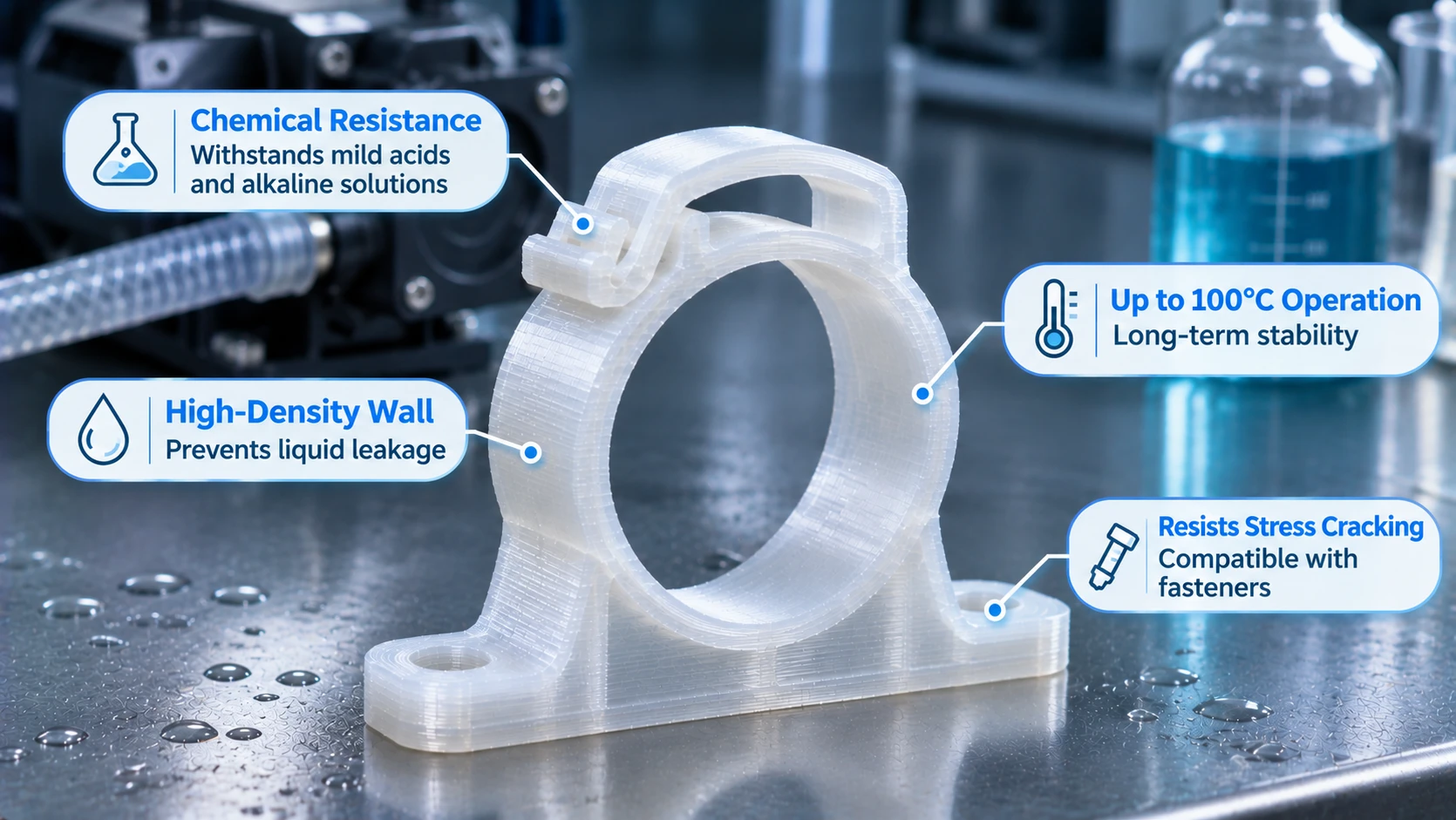
From Cleaning Equipment to Water Treatment: 4 Real-World Uses for Chemical-Resistant Parts Printed with PPpro
3D printing is no longer just for show — many parts can go straight into real use. PPpro’s tolerance of acids, alkalis and salts makes it especially suitable for these 4 scenarios:
1. Water-Treatment Equipment Parts
Positioning rings for filters, flow-guiding nozzles, internal water-dividing baffles. These parts sit in water year-round and may contact disinfectants or water conditioners. Printed in PPpro, they resist not only water but also chemical attack from treatment agents.
2. Cleaning Equipment and Daily-Use Parts
Pressure-washer nozzle housings, detergent bottle caps, robot-vacuum water tanks. These parts regularly touch surfactants and mild acids or alkalis. PPpro’s high resistance to permeation gives them a far longer service life than ordinary PLA prints.
3. Laboratory and Chemistry Tooling
Sampling scoops, test-tube racks and non-critical flow parts in the lab. They cannot handle strong oxidizers such as high-concentration fuming sulfuric acid, but for routine acid, alkali and salt solutions, PP is an excellent lightweight material.
4. Car-Care Accessories
Adapters for car-wash concentrate mixing bottles, drain-tube clamps and the like. Automotive cleaners often contain strong surfactants or organic solvents, and PP keeps excellent stability and toughness in these media.
In closing:
To judge whether a part can be printed in PPpro, first check whether it touches routine acid, alkali or salt solutions or cleaners. If so, and the working temperature stays below 100℃, PPpro will most likely hold up; for strong oxidizers (concentrated nitric acid or fuming sulfuric acid, for example) or specific solvents at high temperature, always run a small-sample soak test before committing.