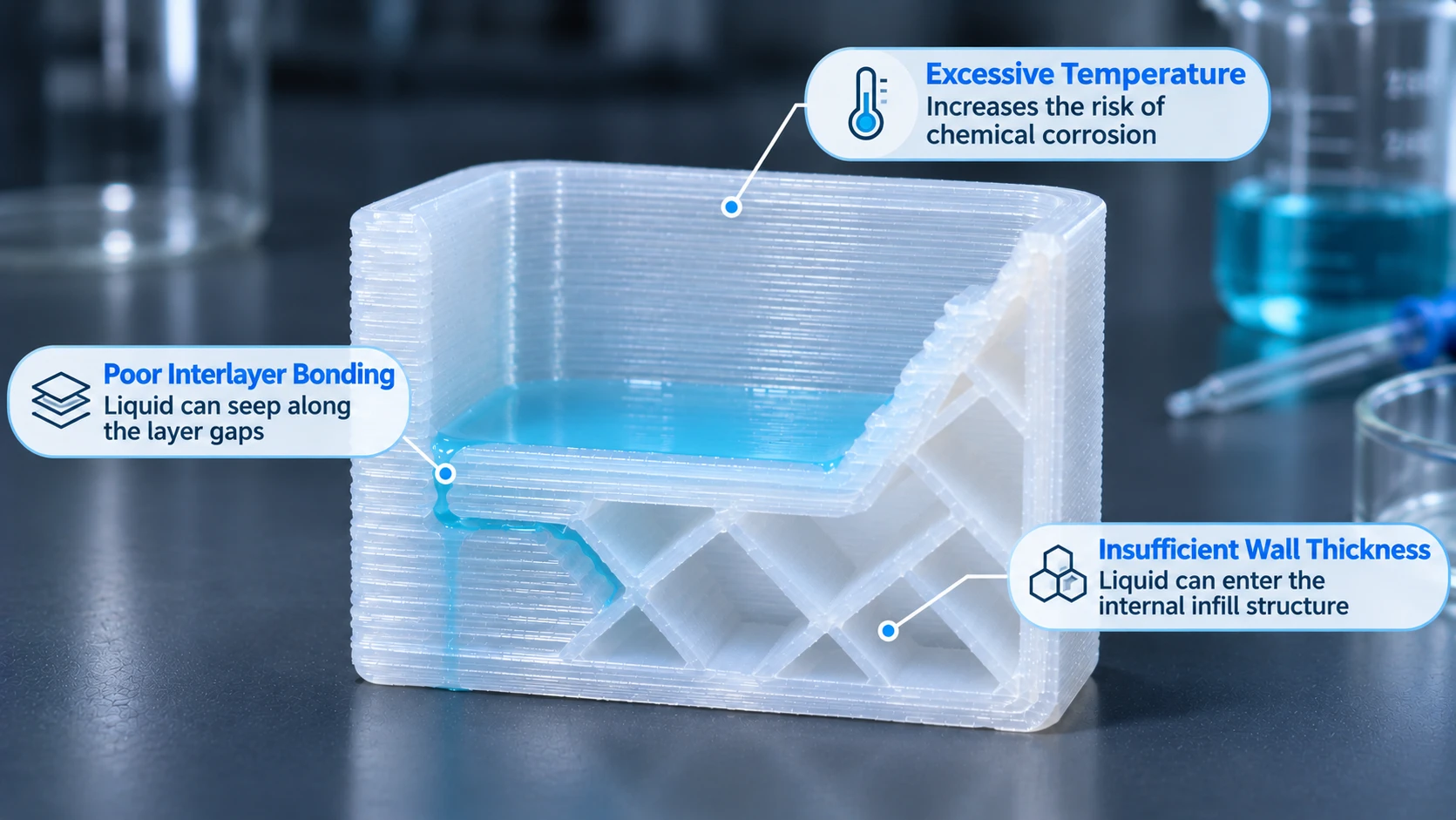
Why Your PP Prints Fail Chemical Resistance: 3 Pitfalls to Avoid
PP’s chemical resistance is excellent by nature, yet many developers find their parts swollen, cracked or leaking after a few fills of detergent or acid.
The reason is that a 3D printed part’s final chemical resistance is decided by “material + print structure” together. Below are the 3 pitfalls many people have stepped into.
Pitfall 1:
Weak layer bonding lets chemicals seep through the gaps
FDM builds layer by layer. If the printing temperature is too low or cooling too fast, layers only “stick” together instead of fully “melting” together. When chemicals come in, the liquid works through the tiny interlayer gaps and the part falls apart from the inside.
How to avoid it:
Raise the nozzle temperature moderately and control PP’s cooling to keep layer bonding dense.
Pitfall 2: walls too thin, internal infill gets soaked
To save material, many people set 15% grid infill. If the outer wall is only one layer, a single pinhole lets chemicals flood the internal lattice, and the liquid is extremely hard to drain. Trapped like that, it erodes the inner walls for a long time and deforms the part.
How to avoid it:
For chemical parts, thicken the top/bottom and side walls (at least 1.2mm-1.5mm or 3+ layers recommended), or simply print 100% solid.
Pitfall 3: heat accelerates corrosion
Corrosion resistance is not constant; the higher the temperature, the faster the chemistry. A material that holds strong acid at room temperature may fail at 60 degrees. PP has excellent heat resistance, but if the chemical itself carries temperature, still run a small-sample soak test first.
How to avoid it:
Keep the working temperature within the range you have actually tested.
Summary:
Designing chemical-resistant prints is not just about “it is PP”. Printing the shell dense, avoiding trapped liquid inside, and knowing the real service temperature are what truly unlock the material’s advantages.