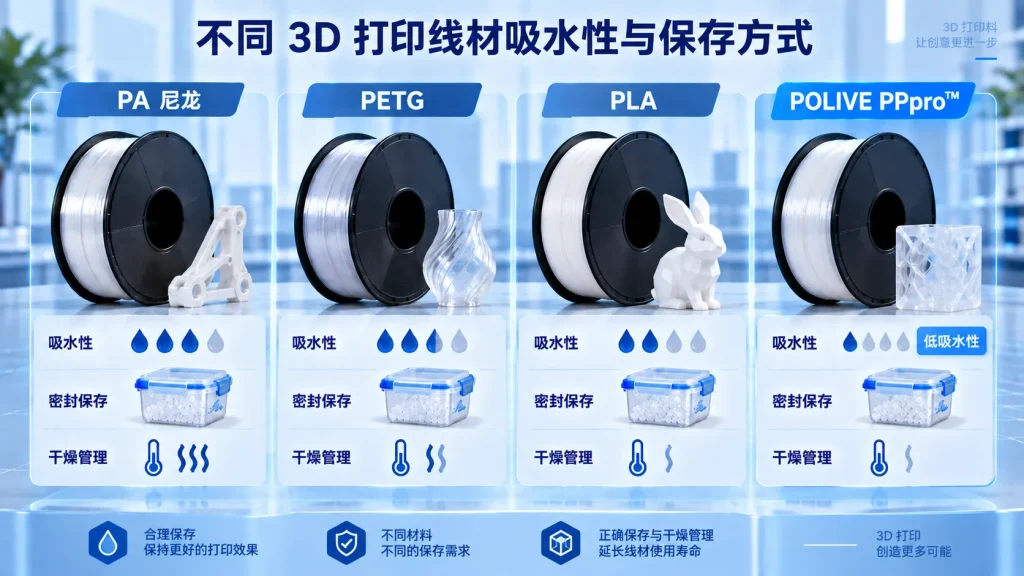
How to Store PP Filament? Low Water Absorption Is One of Its Hidden Advantages
Anyone involved in 3D printing knows that filament storage can sometimes be a hassle.
This is especially true for more hygroscopic materials like PA (nylon), which can absorb moisture from the air over time and affect print quality.
PP, however, has a material property that is often overlooked:
It has inherently very low water absorption.
This is one of the conveniences that makes PP a valuable 3D printing material.
Why are some 3D printing filaments sensitive to moisture?
Different polymers vary in their sensitivity to moisture.
For example:
- PA (nylon): Its hygroscopicity is noticeable; once moist, it may develop bubbles, stringing, and surface-quality issues, and usually requires stricter drying and sealed storage.
- PETG: Its water absorption is lower than nylon’s, but prolonged exposure to humidity can still affect it.
- PLA: It is generally easier to store than nylon, but long-term environmental exposure can still cause changes.
- PP: Its water absorption is inherently very low, so it is usually far less sensitive to ambient humidity.
It should be noted thatBrand, formulation, and filament condition all affect real-world performance,so you cannot simply assume that any PP filament needs absolutely no drying.
Why is PP’s water absorption so low?
PP is a non-polar polymer; water molecules do not easily enter its polymer structure, giving it very low water absorption.
Different test standards, sample states, and data sources can yield different values, so rather than focusing on a single fixed number, it is better to note a practical conclusion:
PP’s water absorption is significantly lower than that of many common hygroscopic engineering plastics.
This is also why PP is usually hassle-free when it comes to filament storage.
Does PPpro™ need to be stored in a sealed container?
For POLIVE PPpro™, the normal recommendation is:
Keep the filament clean and dry, and avoid prolonged exposure to high-temperature or high-humidity environments.
For everyday short-term use, PPpro™ does not require the strict drying management that PA nylon does.
But this does not mean:
“Once opened, PPpro™ can be left anywhere, never needs sealing, and absolutely never needs drying.”
If the filament is kept in a high-humidity environment for a long time, or its surface picks up contaminants like dust or oil, printing can still be affected.
Therefore, if you are not using it for a while, storing it in a resealable bag or sealed box remains a simple and safe choice.
What is the practical significance of PP’s low water absorption for 3D printing?
The biggest advantage is actuallyreduced filament-management complexity.
For users who frequently switch materials, different filaments often mean different storage requirements.
PA requires attention to its dry state;
some materials need long-term moisture protection;
whereas PP’s low water absorption means it usually does not need drying as often.
For home users, studios, and those who frequently test materials, this reduces some extra maintenance work.
PP resists moisture, but print parameters still matter
Two issues need to be clearly distinguished:
Low water absorption ≠ no need for proper printing.
PP’s printing difficulty is mainly not moisture absorption, but shrinkage and warping from its semi-crystalline nature, plus first-layer adhesion and interlayer bonding issues.
So even with well-stored filament, printing still requires sensible settings:
- Nozzle temperature
- Room-temperature printing and heat-bed off
- First-layer speed
- Print speed
- Fan
- Retraction
- Print-bed surface
For POLIVE PPpro™, we recommend starting with the heat bed off and room-temperature printing, then gradually adjusting other parameters based on first-layer adhesion, model size, and actual print results.
A simpler PP filament storage habit
If you want to keep things as easy as possible, you can follow a simple principle:
In use → keep the filament clean and use it normally.
Short-term idle → put it in a resealable bag or sealed box.
Long-term storage → seal it and avoid high-temperature, high-humidity environments.
If the filament already shows abnormal print behavior, then judge whether drying is needed based on the actual situation—rather than making “drying” a fixed step for all PP filaments.
PP’s low water absorption is an easily overlooked advantage
When choosing 3D printing materials, many people focus on strength, heat resistance, color, and price, yet easily overlook the filament’s own storage and maintenance costs.
PP’s low water absorption means:
material storage is usually simpler, and daily use is more worry-free.
This does not mean PP needs no proper storage at all; rather, compared with some more hygroscopic engineering plastics, it is generally more tolerant of humidity.
For users who want to reduce filament-management work while exploring PP’s functional applications, this is also a feature of PPpro™ worth noting.
To learn about PPpro™ parameters such as nozzle temperature, room-temperature printing, first-layer speed, and retraction, see:PP Filament Printing Parameters Explained.
More product information:polive3d.com
PP 线材为什么不像尼龙那样怕潮?
PP 吸水率很低,不容易因吸湿明显增重,所以存储和打印表现比 PA、PETG 稳定,不必像尼龙那样随用随烘。
PP 线材需要密封保存吗?
日常避光、防尘、放在干燥处即可,密封袋或干燥盒是加分项而不是必需。真正要注意的是别让线材表面沾上油污和灰尘。
低吸水性对打印件意味着什么?
尺寸和性能在潮湿环境里更稳定,涉水零件、户外件不容易因吸水膨胀或性能下降;打印前也不用把烘干当成固定流程。
Related Reading
- How to Store PP Filament? Drying, Sealing, and Everyday-Use Tips
- Does PP Absorb Water? Moisture Absorption of PP Filament and Prints
- What to Do When PP Printing Jams? Troubleshooting Steps for Poor Extrusion
- What Is Polypropylene (PP)? PP for 3D Printing from a Materials Perspective
- What Is PPpro? A Modified PP 3D Printing Filament That Needs No Heated Bed and Makes Living Hinges
- How to Judge the Quality of Modified PP Filament? Which Tests to Check When Buying