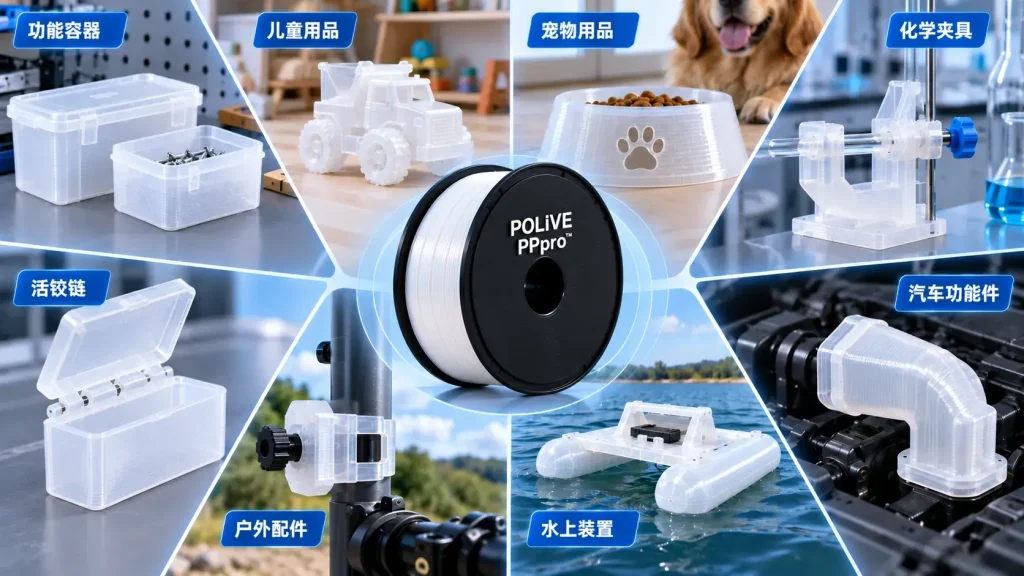
PP fits functional parts: living hinges, snap-fit lids, chemical-resistant containers, lightweight drone parts and water-contact components.
When many people first come into contact with PP 3D printing, they will think of it as another “printable plastic”.
But the real value of PP is often not to print an ornament, but to use its own material characteristics to make someWeight, flexibility, chemical resistance, fatigue resistance or water resistanceThere are functional parts required.
Here are 8 application directions to try.
1. Functional containers and prototypes
PP is widely used in food containers, packaging boxes, bottle caps and other products.
With FDM 3D printing, you can quickly prototype container structures, lids, gauges, and other customized parts.
However, it is important to note:Parts printed using PP wires cannot be identified as food safety products solely by the material name “PP”.
If it is actually used for food contact, it is necessary to further confirm the specific filament formula, additives, printing equipment, processing process, and relevant regulations and testing requirements.
2. Children’s products and toy prototypes
PP has good toughness and impact resistance, so many children’s products and toys can be seen in traditional PP products.
In the field of 3D printing, it can be used to:
- Structural prototypes of toys
- Bendable parts
- Protective elements
- Functional children’s prototype
But “PP” itself cannot automatically be equated with “non-toxic” or “suitable for direct use by children”. Specific products still need to be evaluated according to material formulation and use scenarios.
3. Pet supplies
Pet bowls, storage boxes, toys, and some functional accessories can be the application direction of PP 3D printing.
PP’s water resistance and toughness make it suitable for some products that need to be washed repeatedly or withstand a certain collision.
If pets are involved in direct contact with food, it is also necessary to consider food contact safety requirements separately, not only based on the name of the material.
4. Chemical-related fixtures and container prototypes
The chemical resistance of PP is one of its important advantages in the industrial field.
Therefore, for some parts that need to be exposed to a specific chemical medium, PP can be considered as a candidate material, for example:
- Laboratory Auxiliary Fixture
- Chemical Container Prototype
- Pipeline Auxiliary Parts
- Protective and fixed structures
But PP is not equally resistant to all chemicals. Specific performance will be affected byChemical Type, Concentration, Temperature, Exposure Time, and Material Formulationand other factors.
5. Live Hinges and Repeatedly Bent Parts
This is a very representative application direction of PP.
PP has good fatigue properties, so it is often used in living hinge structures in traditional industries.
With FDM, you can try to print:
- One-piece flip box
- Folding structure
- FLEXIBLE CONNECTIONS
- Functional Parts with Repeatable Opening and Closing
The actual service life is closely related to the hinge thickness, printing direction, layer height, bending angle and printing parameters.
POLIVE has also been tested for live hinge printing on the PPpro™ to verify its repeated bending performance.
6. Outdoor functional accessories
PP’s low water absorption and resistance to moisture and many chemical media make it useful for some outdoor functions, such as:
- Outdoor tools accessories
- Protective shield
- Fixing
- Storing and Connecting Parts
But outdoor applications require special considerationUV aging.
Ordinary PP can not be simply understood as “not afraid of the sun for a long time”. If the product needs to be exposed to sunlight for a long time, it is also necessary to consider the material formula, UV stabilizer, color, environment, and actual use time.
7. Floating installation and buoyancy structure
The density of PP is approximately 0.90 g/cm³is lower than water, so the solid PP material itself has the potential to float.
This makes PP particularly suitable for exploring:
- Buoyancy experiments
- Water structure prototype
- Floating Marker
- Water toys
- Buoyancy Auxiliary Structure
However, whether the actual 3D printed part floats depends onOverall average density, internal fill rate, structural design and presence or absence of water inflow.
Therefore, “PP density is lower than water” and “any PP print will float” are two different concepts.
8. Automotive features and lightweight prototypes
PP has a large number of mature applications in the automotive industry.
PP can be used for some structural parts, guard panels, connectors, etc. in the interior and exterior of the car.
For 3D printing, PP can be used for:
- Prototype Auto Parts
- Custom brackets
- Lightweight structures
- Interior features prototype
- Harness Fixation and Protective Structure
The point here is not simply to copy the injection molded part, but to do it using 3D printing.Rapid iteration and small batch customization.
Why are these apps worth PP?
PP is not superior to PLA, PETG, ABS, TPU or PC on every performance metric.
What’s really valuable about it is the combination of several features:
Low density + toughness + chemical resistance + low water absorption + fatigue resistance
Therefore, when a part has requirements for weight, flexibility, water resistance or long-term repeated use, PP may become a material worth considering.
In the past, traditional PP was prone to problems such as warping, first-layer adhesion, and interlayer bonding during FDM printing.
The development direction of polyive PPpro™ is to optimize materials for these FDM use difficulties, making it easier for PP to enter practical 3D printing applications.
So, what PP 3D printing is really worth exploring is not “how many ornaments can be printed”, but:
Which functional parts, which originally relied on the properties of PP materials, can now also be made quickly through FDM?
Read Next:Can PP 3D printing novices print? 5 Steps to Getting Started
More PPpro™ product information:polive3d.com
PP 适合打印什么?别只打摆件了
它更适合功能件:容器与原型、儿童用品、宠物用品、化工相关夹具和容器、活铰链与反复弯折件,以及需要轻量化、耐化学、抗跌落的实用零件。
为什么这些场景值得用 PP?
因为工况正好对上 PP 的强项:轻、耐化学、抗疲劳、韧性好、吸水率低。摆件用 PLA 就够,功能件才会真正用到这些性能。
打这些功能件要额外改机器吗?
不用加封箱或热床。PPpro™ 不加热床、不封箱,空调房开门开盖散热更快;首层用裙边加 PPLOCK26811,设计上做圆角、老鼠耳朵和均匀壁厚即可。
Related Reading
- What is a living hinge?
- Can 3D Printing Make Packaging Prototypes? Clamshell Boxes, Snap Fits and One-Piece Molding
- Can 3D Printing Make Lab Equipment? Chemical Resistance of PP
- Can 3D Printing Make Drone Parts? Lightweight PP Structural Components
- Can 3D Printing Handle Parts That Touch Water? Tanks, Floats and Bathroom Fittings
- How to Design PP Parts for 3D Printing? Wall Thickness, Fillets, Snap Fits and Warp Prevention