What Does "Skin-Friendly" Mean? The Skin-Contact Safety of PP
Many people call PP "skin-friendly" on the grounds that carbon and hydrogen are also elements found in the human body.
The instinct is right, but the logic does not hold. Sharing elements does not make something safe. Nitrogen is also a bodily element, yet cyanide is built from carbon and nitrogen. Arguing for safety from "the same constituent elements" simply does not stand up.
What Actually Supports Safety Is Structure and Data
PP's relative safety in skin contact rests on several things:
Stable long chains. PP has a molecular weight in the hundreds of thousands, so its large molecules barely cross the skin barrier. Small molecules are the ones that penetrate and trigger reactions, and the PP backbone is not one of those "mobile" species.
No plasticisers, no bisphenol A structure. PP does not need plasticisers to be flexible, and its hydrocarbon backbone contains no bisphenol A. Those two are the risks most often discussed for PVC and PC; PP's formulation simply does not involve them.
Strong chemical inertness and low surface energy. PP does not readily react with whatever it touches, and it does not readily support bacterial growth. In skin contact it is unlikely to release irritants.
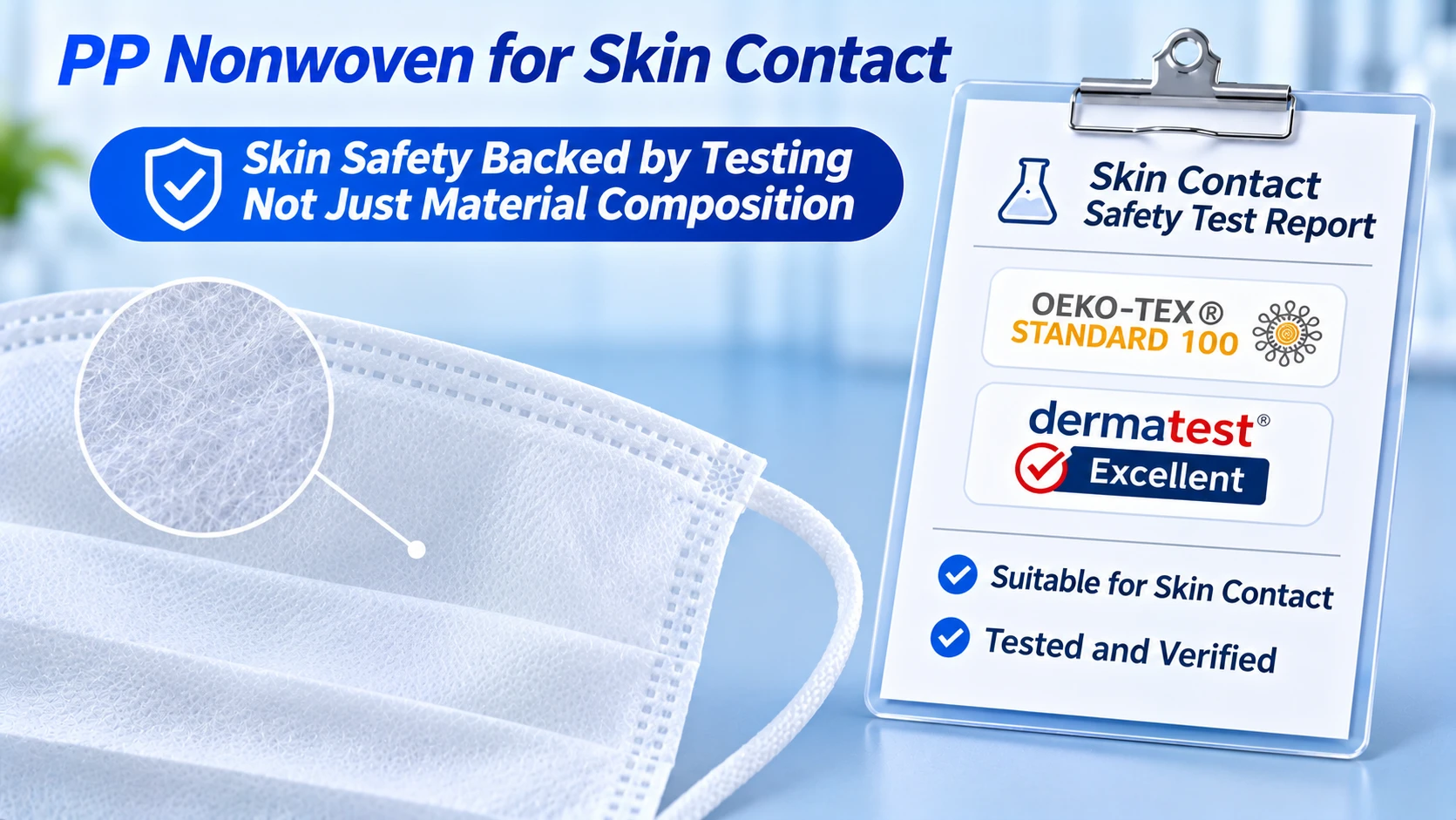
Verifiable test data exists. PP nonwovens are widely used in skin-contact applications — mask inner layers, the topsheet of nappies, and hygiene products all use them. Some PP spunbond fabrics have earned Oeko-Tex Standard 100 Class I certification (the grade approved for baby skin) and Germany's Dermatest low-irritation certification. These are third-party verifications, far more persuasive than "the same constituent elements".
Technoform's material datasheet states it plainly: PP is "odourless and non-irritating to the skin". KIPP's material page likewise notes that, owing to its molecular composition, PP "does not irritate the skin and is physiologically harmless".
But "Skin-Friendly" Is a Term to Use Carefully for Plastics
The more accurate term is "skin-contact safety", not "skin-friendly".
"Skin-friendly" has a specific meaning in textiles and cosmetics, usually referring to softness, breathability and low allergenicity. Applied to a plastic raw material, it is easily read as an overclaim. PP is a pellet, a filament, a printed part — it is not itself "soft and breathable". What is soft is the form it takes once made into a nonwoven, not the PP material itself.
When describing it externally, add qualifications — for example, "chemically stable under normal conditions of use and unlikely to cause skin irritation". If test reports are available, showing data is more convincing than arguing the case. Saying "passed skin irritation testing" is far safer than saying "skin-friendly".
Do Not Carry Nonwoven Safety Conclusions Straight Over to 3D Printed Parts
There is a large body of skin-contact safety data for PP nonwovens, and masks and nappies rely on it. An FDM 3D printed part is a different matter.
A 2026 study published in Scientific Reports systematically evaluated the effects of 16 commercial 3D printing filaments on human dermal fibroblasts. It found that some PP filaments showed "hidden cytotoxicity" — cell counts looked normal, yet single-cell metabolic activity was falling significantly. The researchers noted that cytotoxicity was driven mainly by proprietary additives and thermal-degradation by-products formed during printing, so the biosafety of a 3D printed part cannot be inferred from the polymer base resin alone.
That study is not saying PP filament is unsafe. It says the safety of a printed part depends on the specific formulation and process, and you cannot carry "PP itself is safe" straight over to the part. The skin-contact safety of PPpro likewise needs test data for the specific grade to back it up; it is not automatically inherited from PP's material nature.
Conclusion
PP's relative safety in skin contact rests on stable long chains, the absence of plasticisers and bisphenol A, strong chemical inertness, and a large body of verifiable test data from the nonwovens sector.
But "skin-friendly" tends to overclaim when used for a plastic raw material. The accurate term is "skin-contact safety", with qualifications and test data to back it up. 3D printed parts especially cannot borrow nonwoven safety conclusions: additives in the filament and the printing process also shape the final result.
Common Questions
Why Are PP Nonwovens Used as Mask Inner Layers?
PP nonwovens are backed by skin-contact safety data. Some PP spunbond fabrics hold Oeko-Tex Standard 100 Class I certification (the grade approved for baby skin) and Germany's Dermatest low-irritation certification. Add softness, breathability and low water absorption, and they suit direct skin-contact applications.
Can the Term "Skin-Friendly" Be Used?
Use it with caution for a plastic raw material. "Skin-friendly" has a specific meaning in textiles and cosmetics (soft, breathable, low-allergenicity), and a plastic is not itself "soft and breathable". Prefer "skin-contact safety", qualified with "under normal conditions of use", and show the test data where you have it.
Are PP Printed Parts Safe in Skin Contact?
It cannot be inferred directly from the PP material. A 2026 study of 3D printing filaments found that the effects of some PP filaments on cell metabolism were linked to additives and thermal-degradation products; the polymer base resin alone cannot guarantee a safe printed part. The skin-contact safety of PPpro needs test data for the specific grade and is not automatically inherited from PP's material nature. Before making parts worn against the skin or in prolonged contact with it, check the filament's biocompatibility testing.
Can PP Printed Parts Stay in Contact with Skin for Long Periods?
PP itself is chemically stable and does not absorb water, so it is a common skin-contact material. We print PPpro with no heated bed and no enclosure, without extra coatings or post-processing in a sealed chamber; after a simple surface clean, parts are ready for wearable and hand-held prototype evaluation.
Does "Skin-Friendliness" Have Anything to Do with Your Printing Process?
Yes. Printing open-frame on a room-temperature plate means no high-temperature additives from a sealed chamber and no repeated spray-adhesive touch-ups; one coat of PPLOCK26811 on the plate lasts for multiple prints, and the finished parts carry no coating, which makes skin contact less of a concern.
Will PPLOCK26811 Adhesive Remain on the Printed Part?
The adhesive is applied to the build plate and left to dry before printing; it is not sprayed onto the model. Normal parts come off with no residue, and if a spot does transfer, a wipe with alcohol cleans it off.
What Should Be Considered in the Design of PP Parts That Touch Skin?
Rounded fillets instead of right angles, uniform wall thickness and slightly thicker edges all reduce layer lines and burrs that trap dirt; these are also our standard design measures for reducing warping in PP, so they do two jobs at once.
Is Annealing or a Second Enclosure-Based Treatment Needed Before Skin Contact?
No. Our approach is open-frame printing in an air-conditioned room, letting PP carry the heat away naturally as it sets — no extra heating, no enclosure, no high-temperature post-processing. Parts can go into trial evaluation after a wipe with alcohol.